The Science Behind Early Learning: Ellen Galinsky

The Science Behind Early Learning: Ellen Galinsky

The full collection of video conversations can be found here.

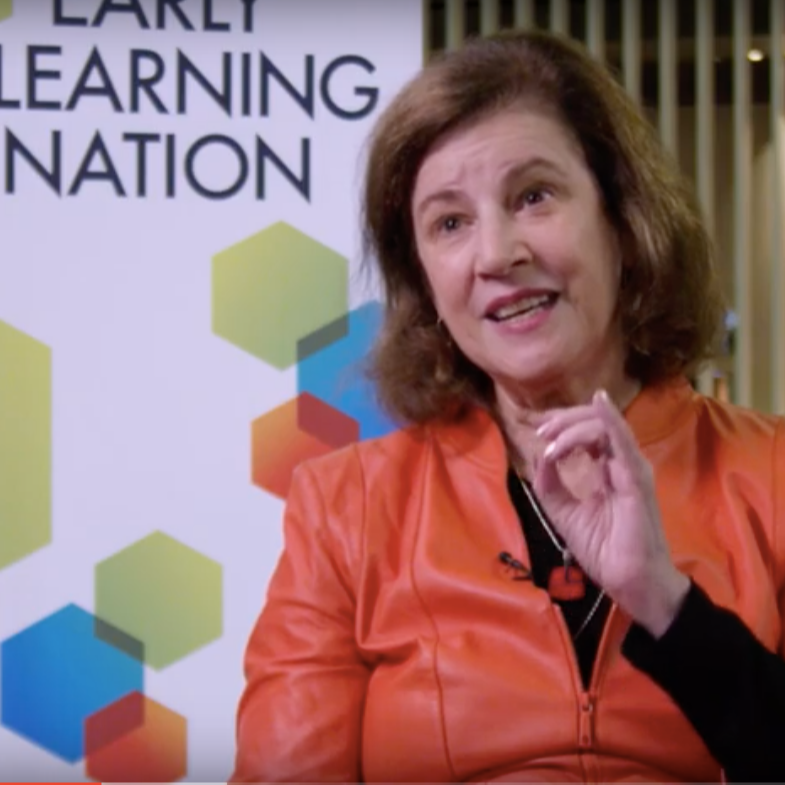
One of the global pioneers behind the science of early childhood learning and development, Ellen Galinsky, chief science officer at the Bezos Family Foundation and executive director of Mind in the Making, discusses her landmark book, Mind in the Making: The Seven Essential Life Skills Every Child Needs, as well as her next project, which includes exploring the mind of the adolescent.

Transcript: Ellen Galinsky, Bezos Family Foundation and Mind in the Making

Early Learning Nation: Ellen, welcome to the Early Learning Nation studio.

Ellen Galinsky: It’s a pleasure to be with you.

Early Learning Nation: There’s so much that we could talk about with you on the topic of early childhood learning. But maybe let’s start with your book, Mind in the Making and The Seven Essential Life Skills Every Child Needs. It was a groundbreaking book. But let’s go even before that, what sparked your interest in the topic in the first place?

Ellen Galinsky: I didn’t start out to write a book, I really didn’t. I started out to make some videotapes for teachers to share the best research. I was doing a study of young people, kids from the sixth through the 12th grade and I was asking them about learning and I found, just in the preparation for that study that too many young people were turned off from learning. My question was what are we doing to turn kids off from learning? I went back to the best research actually doing focus groups listening to parents, they said, “I don’t want to hear research says, I want to know the researcher, I want to know how she or he knows what that researcher knows about my child.” That was a very big turning point for me, so I, with the camera crew, went out to ultimately about a hundred of the best researchers in the United States and abroad and looked at their research.

As I was doing it I began to see these patterns and began to see that the kids who were thriving were the kids who had these skills, I ended up calling them life skills, because they’re important to the young children, but they’re just as important to us as adults. The first skill is focus and self control. That means being able to pay attention to what’s important, to think flexibly, to use the information you have and to have the self control to be able to reach your goals. People who are most likely to succeeded have goals and reach them.

Perspective taking means to understand how I think and feel and how you think and feel and how that might be different. That is critical in understanding the world, the social world that exists, but it’s also critical in avoiding conflict. Communicating is being able to think about what it is you want to say, how it will be heard so you therefore communicate much more effectively.

The next skill is making connections. All knowledge is based on symbolic representations, that is five stands for this number of fingers. But making unusual connections is the basis of creativity, which is a very important again in a changing world. Critical thinking, the search for valid and accurate information, because we base our behavior on what it is we think and believe to be true. Taking on challenges is more than coping with stress, it’s trying something that’s hard. My mother would call it getting on a horse when you fall off. I don’t know that that many people do that anymore, but it’s maybe getting on the bike or trying that math problem-

Early Learning Nation: You get back on the bike. A lot of people get back in horses, but yes, the bike.

Ellen Galinsky: Finally, being a self directed, engaged learner. Because, I think, for all of us to thrive we need to be caring about something that we want to learn about. That’s the importance of Early Learning Nation.

Early Learning Nation: Who’s the audience for the insights that you found and the conclusions that you came to?

Ellen Galinsky: Well, it may sound obnoxious, but everyone. These are life skills, because they’re just as important to me. If I have a fight with someone, if I disagree with someone, understanding why they’re behaving, being able to take their perspectives is critical in being able to solve a problem. They’re very important for children to learn, because they are based on executive functions of the brain and the periods where those skills are developing most rapidly are the preschool years and then later on in adolescence.

Early Learning Nation: I could imagine this being very useful in an office, really any personal relationship. The Mind in the Making book, as it were, of course it has moved well beyond the printed page.

Ellen Galinsky: We are.

Early Learning Nation: There are some very exciting developments, particularly in the medical field. Can you tell me some of the work that’s going on and that you’re doing in the medical field?

Ellen Galinsky: I didn’t want this to be a book and just sit on the shelf, although it continues to jump of the shelf, for which I’m deeply grateful. I wanted the knowledge to be there and useful for people. One important thing was to have a common language that people could begin to understand behavior in systematic ways. Another thing was to make this knowledge into things that we could act on. Among the things that we’ve done is we’ve taken this child development knowledge at the Bezos Family Foundation and we’ve worked with Mount Zion Parenting Center and their 17 minutes and a Well-Child visit, and we have taken all of the Well-Child visits from birth through five and we’ve put child development information into every one of them.

Bringing science into action, most pediatricians get asked about behavior issues and they don’t really know, they’re not trained in their typical medical training, which is what Mount Zion is doing and will available free for doctors all over the country. We’ve also created what we call skill building opportunities, which take the challenges that teachers or parents or anyone involved in, grandparents, anybody involved in the life of a child. “My kid is addicted to screen time. I have a picky eater. My kids are fighting,” all those problems that are normal, and turn them instead of seeing them as managing bad behavior, you can see them as a way and opportunity to teach and promote a skill.

We’ve created a list of books, library of books and materials, and we talk about how to read these books in ways that promote the life skills. Room is another product that we’ve created at the Bezos Family Foundation, that have tips for the time you already have with children. They turn everyday moments into brain building moments. We have modules that help people learn the science and then infuse it in their practice or in their lives, whether they’re a parent or a professional.

Early Learning Nation: Ellen, the science that you have done and the science for Mind in the Making focused on the youngest among us, zero to eight, we’re all grateful for that. I’ve got adolescents, when are you going to turn the science and start to focus on adolescences? Any plans there?

Ellen Galinsky: Absolutely. I’ve been working on this for three to four years.

I’ve first looked at the literature very intensely. Then went out again through the foundation with a film crew and filmed about 35 of leading researchers on adolescents’ development around the world. Next, I’m going to be writing a book and at the foundation we’re going to be creating all kinds of materials for adolescents, including, what I hope we do is materials for adolescents to understand their own development, it’s really pretty interesting.

Early Learning Nation: I bet.

Ellen Galinsky: Adolescents are pretty misunderstood. Why they act the way they act is actually very positive, and what they need to learn in their life. If we can begin to meet those developmental needs of adolescents I think it will be much less conflict late in time.

Early Learning Nation: There would be lines of parents waiting to, not only get your book but probably just to say, “Thank you.”

Ellen Galinsky: Thank you.

Early Learning Nation: I should probably then let you go, because you need to go finish that work fast, people need it. People like me.

Ellen Galinsky: Thank you.

Early Learning Nation: Thank you, thank you so much.

Reprinted from Early Learning Nation

 

Dads Spending Time on Baby, Not Baby Talk

Dads Spending Time on Baby, Not Baby Talk

Fathers want to step up at home when it comes to caring for their children.

But stepping up involves speaking up—to their babies—which they may be less likely to do, according to a study published in the December 2014 issues of Pediatrics.

This study, led by director of the Providence, Rhode Island Women & Infants Neonatal Follow-Up Clinic, Betty R. Vohr, MD, FAAP, equipped babies with microphones and asked the parents to turn them on when both were around.

In looking at the data over time, they found that babies heard more words from mothers than fathers, and that fathers were less likely to speak in what researcher Patricia Kuhl of the University of Washington calls parentese than mothers. When parents speak parentese, they slow down their speech, their voices are musical, and their facial expressions are dramatic. Babies much prefer parentese, and they learn more when parents speak this way.

Why does this matter? Because fathers may be losing an opportunity to help their babies learn language, which is the single best predictor of how children do in school, according to many, many studies.

Myths about generational difference abound, but there is one change that’s anything but a myth. It is that younger fathers— especially Millennials and Gen Xers—are much more committed to being involved in their children’s lives and are spending more time being with and caring for their children than fathers in other generations.

Fathers don’t want to be stick figures in their children’s lives!

Unfortunately, so much of the research on children’s learning has been focused on mothers, but that needs to change.

This new study in Pediatrics is unique in that it includes fathers as well as mothers. Yet it like many other studies counted the words that children hear and that is only part of the story.

A study that is being featured today as a keynote at the Annual Conference of the National Association for the Education of Young Children (NAEYC) in Dallas shows that counting words is not enough. The researchers (Kathy Hirsh-Pasek of Temple University, Roberta Golinkoff of the University of Delaware and Lauren Anderson of Georgia State University) found that the way that mothers (yes, only mothers were studied) talk with children matters more. Three things stand out in predicting children’s later positive language development:

  • the adult cares—they are engaged in looking at and talking about something that both are interested in;
  • they have done this before—the child knows what to expect because they have had conversations (with and without words) like this before; and
  • the conversations are fluid and connected—they go back and forth, back and forth, back and forth.

It is so important to tell the whole story when reporting research to families and professionals.

From the study in Pediatrics this week, all of us can learn how important men are to the development of children’s language. From the study being featured at NAEYC, all of us can learn that it is HOW we talk to young children that makes all the difference.

Ellen Galinsky has been committed to telling the whole story of child and brain development research through Mind in the Making. She is the Bezos Family Foundation Chief Science Officer and Founder/Executive Director of Mind in the Making. As president and co-founder of Families and Work Institute (FWI), she helped establish the field of work and family life during the time she was at Bank Street College of Education, where she was on the faculty for 25 years. Her more than 100 books and reports include the best-selling Mind in the Making: The Seven Essential Life Skills Every Child Needs, Ask The Children, and the now classic The Six Stages of Parenthood. She has published over 300 articles in journals, books and magazines. She co-directs the National Study of the Changing Workforce, the most comprehensive nationally representative study of the U.S. workforce–updated every five to six years.

Jacklyn “Jackie” Bezos is committed to telling the whole story of child and brain development research through Vroom. She is president and co-founder of the Bezos Family Foundation, which supports rigorous, inspired learning environments for young people to put their education into action. Through investments in research, public awareness and programs, the foundation aims to elevate the field of education and improve life outcomes for children. At the core of the foundation’s work is a belief that all young people deserve the chance to achieve their full potential and make a meaningful contribution to society. Through the foundation, Bezos has pioneered collaborative initiatives that give young people a platform to co-create solutions, including the Bezos Scholars Program at the Aspen Institute, the Aspen Challenge and Students Rebuild.

Reprinted from The Huffington Post


Understanding the Language Of Children’s Behavior: Lessons From the Research of Berry Brazelton

Understanding the Language Of Children’s Behavior: Lessons From the Research of Berry Brazelton

On May 10, 2012, pediatrician T. Berry Brazelton turned 94 years old. On June 18, 2010 The White House honored him as a Champion of Change. On February 15, President Obama awarded Dr. Brazelton the Presidential Citizens Medal, the nation’s second-highest civilian honor.

If you asked this inspirational man—this Professor of Pediatrics Emeritus at Harvard Medical School, this author of the best-selling Touchpoint books, this star of the long-running Lifetime Television show What Every Baby Knows, this founder of the Brazelton Touchpoints Center—what his most significant accomplishment is, as I did when he received the Families and Work Institute’s Work Life Legacy Award in 2010 and when I interviewed him for Mind in the Making, he said: “The Newborn Assessment was really probably the most important thing I ever did for the field.”

The Neonatal Newborn Assessment does, in fact, well represent Brazelton’s larger contributions, because it, like his other work, helps parents and professionals understand the language of children’s behavior and helps us all feel more competent in teaching and caring for children.

Brazelton’s passion to understand children has deep roots in his Texas childhood:

As the oldest grandchild of about nine, my grandmother, Berry—whom I was named for—always wanted me to take care of these other cousins for every event that went on at her house. And since I had eight small children to care for, I had to learn how to get inside of them and see how their brains were working. I found that so fascinating, because once you’ve understood what they were doing, you could take care of eight children at once.

His passion to understand children also has roots in his disdain for the typical attitude among professionals about parents when he began practice as as a pediatrician in the 1950s. Hre recalls, “Everybody blamed the parents when things went wrong with the child.”

Brazelton realized—especially from being a parent himself—that children’s behavior affects parents just as parents’ behavior affects children. It is a two-way street. So he became committed to help parents start this journey of parenthood in a positive direction.

Brazelton also felt that most people didn’t fully understand the capacities of newborns. He remembers that even as late as the 1970s. “We still didn’t think babies could see or hear. Where did we get such a stupid idea?”

But he observed something different. He saw that newborns, even just after birth, had many unique ways of being connected to what was happening around them. It seemed to him that if we as adults could find better ways to tune in to what infants were doing, we could better understand their experiences. To help doctors and families interpret the “language” of the newborn, Brazelton created the Neonatal Behavioral Assessment Scale as a translation and assessment tool.

Observing that the typical newborn pediatric examination at that time tended to over-stimulate newborns, Brazelton saw that the way a baby responds to stimulation tells us a lot about the baby’s inborn temperament. He also saw that when babies react to over-stimulation by turning away or falling asleep, this is a positive response—it’s the beginning of self-control.

I have accompanied Brazelton into the hospital rooms of newborns and their parents immediately after childbirth and watched him use the Brazelton Neonatal Behavioral Assessment Scale with these tiny infants in their first few moments in the world. He holds the baby gently and exclaims over him or her to the parents and then conducts his assessment, which includes stimulating the newborn with a flashlight and a rattle.

These babies, born just minutes or hours before, typically startle at the noise or light and then find a way to recover — by sucking a finger, shutting their eyes or turning away from the commotion.

The way the baby calms down tells the parents and pediatrician something about how this particular baby responds to a new and somewhat challenging experience. Brazelton then talks to the parents about their child’s style of controlling emotions and about how important this skill is to the child’s later development. And that’s precisely the goal—to help parents understand their unique child and give them confidence. He says:

The goal for the Neonatal Assessment was to share this assessment with parents so they understood what kind of person they were getting and could put all of their passion right where it belonged—with that child.

The question I’ve always gotten from a new parent is, “How am I going to know what kind of person this is?” And as soon as you play with a baby, you know!

Not content to rest on his laurels, Brazelton enumerated the work yet to be done when he was honored by The White House, concluding: “We can and must do more. I’m 94 years old, but I’m not done. There’s more to do.”

When I think of what being a parent was like when my own children were born versus now, I am forever grateful for all that Berry Brazelton did!

Reprinted from The Huffington Post

A Moment We’ve Been Waiting For!

A Moment We’ve Been Waiting For!

You may wonder why I am cheering as loud as I can about today’s release of the National Academy of Sciences report that answers the question: “Does quality early childhood education lead to more successful lives as adults?”

It’s because the Academy’s answer is a resounding YES!

Exactly 30 years ago—the fall of 1990—I was speaking to a “live” cheering crowd of 5,000 members of the National Association for the Education of Young Children. The legislation for the Child Care and Development Block Grant was coming up for a vote (it passed, as you know) and we wanted to make sure that:

  • Child care and early education were seen as inextricable. “Children can’t learn if they aren’t cared for” was one mantra.
  • The focus has to be on quality. We worried about over promising the impact of early education without an explicit quality assurance.
  • It was known that teaching and caring for young children requires enormous knowledge and skill. When asked what we did, some of us said, “Investments?” “Oh, stock and bonds?” was the answer. “No investing in young children,” we replied.
  • All children deserve quality, not just some. Equity must be a focus.
  • This would require new funds from government, business and philanthropy. Otherwise, the three-legged stool of quality, accessibility and affordability would collapse.

The report released today—which is backed by decades of research—addresses all of these concerns. Listen to my interview with scholar Dr. Patricia Kuhl of the University of Washington. She’s one of 12 councilors to the National Academy of Sciences and shares with me the backstory on the Academy, along with key report findings. After you watch, I hope you will cheer along with me… and help spread the word!

Critical Thinking—The Gift of Curiosity: Lessons from Laura Schulz

Critical Thinking—The Gift of Curiosity: Lessons from Laura Schulz

Have you ever noticed that your toddler spends more time playing with the gift-wrapping than the present that was wrapped inside? Or that your older children lose interest in a new toy if that toy has just one way to play with it, and instead gravitate back to materials, like blocks, crayons, miniature animals or iPads where the possibilities are endless?

I have been writing on the researchers and neuroscientists who have genuinely inspired me in my journey to create Mind in the Making, I am sharing the story of Laura Schulz of MIT. Her studies help explain what curiosity is and thus how to promote children’s curiosity in the gifts we give them.

I am not sure about other parents, but I didn’t think too much about curiosity except to assume that my children were naturally curious. They wondered about everything that was new and were bursting with endless questions: “What’s that?” And, “Why, why, why.” Interestingly, however, the research on children’s curiosity reveals that is it far more complex than this.

Laura Schulz has been being curious about curiosity throughout her career and finds not surprisingly, that children—in fact all of us—are curious about what’s new. But there are other drivers of curiosity. Schulz explains:

We often seem to be curious about things that aren’t particularly novel—they just puzzle us.

Her quest to understand curiosity has led to new insights:

I think there are two different things that can provoke curiosity. The simplest one is a violation of your prior beliefs. You go into an experience with a certain expectation that “this is the way the world is,” and then you see some evidence that’s inconsistent with that.

When this happens, Schulz says:

You have to do something with that evidence. You can deny it. You can try to explain it away. You could realize that your beliefs are wrong and that they have to change. But one way or another, you need more information to figure out what to do.

Children also become curious when they have two competing expectations or theories. Schulz elaborates:

The other time you might be curious is if you see evidence that fails to distinguish among competing beliefs. There are many things that might be true, and the evidence just doesn’t determine which one is the case.

In scientific terms, when people are trying to understand how things work, they are typically trying to understand causal relationships—what causes something to happen. A toddler might be trying to understand what happens if she pushes her rubber duck underwater in the bathtub. Does it always rise back up to the surface? Yes, it does. That kind of evidence, in scientific terms, is “unconfounded”—there’s a clear and consistent cause and effect. When Schulz talks about “competing beliefs” where “many things might be true,” she’s talking about “confounded evidence”—it’s not clear exactly what the causes are.

Schulz and one of her graduate students, Elizabeth Baraff Bonawitz, created a study to further explore the question of when children remain curious. They designed a red jack-in-the-box toy that has two levers, one on each side. When both levers are pushed at the exact same time, two toys—a straw puppet and a duck—pop up. This toy demonstrates a “confounded” experience: there’s no way to determine how the toy works simply by looking at it. Maybe it takes both levers to make the toy work or maybe it doesn’t.

In the experiment, an experimenter shows preschool-aged children this toy. The experimenter says to each child, “You push down your lever and I’ll push down my lever at the same time.” They count to three and each pushes one of the levers. Both the puppet and the duck pop up. Although they repeat this action several times, the child can’t figure out from this process which lever controls which pop-up toy.

A second group of children is introduced to the toy in a different way. After the experimenter and the child push down the levers at the same time, they each take turns. The child can easily see which lever controls the duck and which lever controls the puppet. Then, as Schulz explains:

We take that jack-in-the-box away. We bring it right back out along with a brand-new box that the children have never played with before.

Normally, children would be drawn to the new yellow toy because children are curious about what’s new. But that didn’t happen for one of the groups of children in the experiment.

The researchers found that the children who knew how the old red jack-in-the-box worked (that is, they had unambiguous or unconfounded information) went to play with the new box. But the children who didn’t know how it worked (they had ambiguous or confounded information) kept playing with it, as you will see in this video of the experiment.

There are some very important lessons for me in this study by Laura Schulz. The first is to give children gifts that puzzle them, that intrigue them, that make them want to find out more. Rather than toys with just one way to use them, give them toys that can be used in many ways–that’s why the classic toys (like materials to use in building and creating or exploring) remain classic.

But the second lesson is far more important. It’s how we respond to children when they ask us their endless questions—”What’s that?” or “Why, why, why.”

Often we are so busy that we want to slough off their questions or tell what we think so we can finish everything on our to-do lists. But if we want our children to remain curious, we will find times when we can stop, notice what they are curious about and then ask them questions to keep them curious and wanting to explore. For example, we might say:

Why do you think that rubber duck always pops up when you push it underwater in the bathtub? Do you think if you put a washcloth on top of it, it would stay underwater? Do you think your empty shampoo bottle would float? Do you think it would float if we filled it with water?

Or with older children, we might say:

Why do you think your friend seemed unhappy at the party? Was it something that might have happened to her? Was it something that happened between you? What might make things better for him?

It is by remaining curious that children learn, whether about the natural world or about people. And that is a gift that lasts!

Reprinted from The Huffington Post

Taking on Challenges—Helping Children to Learn to Take on Challenges: Lessons from Heidelise Als

Taking on Challenges—Helping Children to Learn to Take on Challenges: Lessons from Heidelise Als

This is part of a series to share the findings of child development researchers and neuroscientists who have genuinely inspired me in my journey to create Mind in the Making. Their research is truly “research to live by.”

I’m writing about Heidelise Als of Harvard University, because her studies are so instructive in how we can help children deal with challenges and learn to become stronger as a result. Perhaps surprisingly, learning this skill doesn’t just happen when children are older. Als’ research is with pre-term babies born 10 to 12 weeks before their due date—the most fragile babies in neonatal intensive care units. When adults watch what young children do to cope successfully and then create situations where they can do more of the same, the process for learning to take on challenges is seeded.

The insight that led to Als’ research began in her native Germany when she was as a teacher of 3rd grade boys. One of the boys, Reinhart, always came to school early, sat in his seat close to the front of the classroom, lined up all of his pencils and books on the desk and was ready for the day to begin. Since Reinhart was doing very well and got good grades, Als decided to move him farther back in the room so another child who needed extra help could have a seat in the front. She says:

Reinhart moved promptly, yet the next day he didn’t come in. He had never missed a day of school. I was very concerned. He didn’t come the next day.

After a few days, Als stopped by the bakery Reinhart’s family ran. His mother told her that the doctor couldn’t find anything wrong, but her son had been vomiting. The clue came when Reinhart’s mother mentioned, “He did tell me you moved his seat, and he’s now sitting farther back.” Als says:

I learned from that that despite seeing the image of a very competent child, I should have known from his need to have everything lined up at the start of the school day—that he didn’t have the flexibility that other children had.

Reinhart was given his old seat back when he returned to school, but Als gained even more from that experience. She learned how important it is to “read” the language of children’s behavior, to figure out how they cope best and then build on their own positive coping strategies. This lesson was reinforced after she moved to the U.S. to attend graduate school and had her own child, who is significantly brain damaged. She had to learn to understand the language of his behavior in order to help him.

Als brought that sensitivity into her research on premature babies. Through advances in technology in the 1970s, these babies, who couldn’t yet breathe on their own, could be kept alive with medical ventilators that, in effect, breathed for them. What really interested Als was “to see what these babies were up against” and how they were handling these stressful situations.

As she observed them, it became clear to her that good medical care was coming at the price of good developmental care:

The premature babies would be pinned down, held down, strapped down, and even chemically treated, if needed, so that they would not breathe against the ventilator in order to let the ventilator do the work that it needed to do.

A similar kind of scene took place when a nurse or doctor wanted to check on a baby, listen to the baby’s heart rate or change him or her:

The baby would just splay out—all four limbs would fly out, and then the baby would try to grasp at something, but the nurse by then would already be putting her stethoscope on the chest, listening to the chest sounds. And then she would turn the baby over again and listen to the back, and then she would start to suction his lungs and then she would give a nebulizer treatment.

As the check-up progressed, Als reports, babies would become more and more distraught; finally, they would “go limp and typically stop breathing.” It was clear to Heidelise Als that the medical care was so focused on caring for these premature babies’ hearts or lungs that they were neglecting the care of the whole child:

It seemed we were wasting a lot of the baby’s energies that were very precious. We were going against the baby. We were pushing the baby to become exhausted and give in.

When a baby who was initially feisty gave in, the medical charts would record that the baby had become well adjusted. But Als saw a different reality:

The baby had given up. The baby just let the world happen.

Als and her colleagues—nurses and doctors—set out to improve developmental care and to document that it can make a difference. They thought of this as listening to their behavioral “language.” She says:

If we can understand the ‘words’ the baby is saying, maybe we can fill in the meaning of the sentence and understand the message.

These observations led to solutions. For example, if the baby’s hands splay out, give the baby something to hold onto. If the baby is squirming under the bright lights, make the lighting softer. If the baby is getting agitated, hold the baby until his or her breathing becomes more stable. After documenting and recording behavior, they launched into a study where the nurses “read” and then responded to the baby’s behavior in ways that built on that baby’s coping strategies, and thus gave the baby more control.

The results of this experiment were impressive. There was reduced severity of chronic lung disease in these premature babies, improved brain functioning, improved growth and earlier release from the hospital. In addition, their care was significantly less costly.

Here’s the lesson I take from this. Children, even those as young as premature infants, are less prone to the harmful effects of stress when they are supported in managing their own stress by being helped to use the strategies they have for coping and for calming down.

And when children are older, they can become an even more active part of figuring out themselves how to deal with tough times.

Als tells the story of a child for whom any reminders of 9/11 (like fire trucks) would trigger emotionally flooding. With the help of adults, he created his own strategy to calm down. He would put his head down on the table to “think” and would wait until he had “thought enough”—and then he was ready to go on.

From these studies, it is clear that we can help children learn to handle tough times if we enable them to become increasingly active partners in creating their own solutions. It has worked for me and it has worked for my children. What about you?

This story is taken from Mind in the Making.

Communicating—Helping Children Learn to Communicate: Lessons from Anne Fernald

Communicating—Helping Children Learn to Communicate: Lessons from Anne Fernald

This article continues my series to share the research of child development researchers and neuroscientists who have genuinely inspired me to create Mind in the Making. Their work is truly “research to live by!”

I am sharing the story of Anne Fernald of Stanford University because her studies provide important insights into helping children learn to communicate. This is an increasingly salient issue in our times where there is widespread concern that communicating has been reduced to spitting out sound bites rather than illuminating the complexities of situations, texting rather than connecting, and reducing thoughts to 140 characters.

Anne Fernald has been a pioneering researcher in studying the origins of human communication, but she didn’t start out to do this kind of work. Her original interests were in literature. All of that changed when she went to live in Germany, far from home, surrounded by a language, German, that she initially didn’t understand. The stark contrast in the culture and the language caused her to look back not only on her own culture and language in new ways, but also to begin to probe the very nature of communication. This was accelerated by the birth of her two children. Fernald says, “Our children were born there. Becoming a parent in another language is a wonderful experience because it gave me distance.”

Fernald pulled back and observed what happens in everyday moments. She says:

What drew me to the study of language was a moment of epiphany. One of my dear friends had a baby a few months before our second daughter was about to be born, and I was asked to be the godmother of this child. I went to the hospital on the second day and my friend put her newborn child into my hands to introduce us.

To her own surprise, Fernald introduced herself to her godchild in singsong German, “I immediately thought: now where did that come from? Was this a performance for her German-speaking mother? Or was I just intuitively trying to engage with this newborn baby?”

Not only was Fernald acutely aware of her words, but she was also struck by the fact that she was singing them. When her own baby was born a few weeks later, she found herself singing the same kind of melody to her newborn—this time in English.

Fernald’s experiences in a new country led her into what has become a lifelong study of communication, beginning as a volunteer in a scientific center studying infant development in Germany and continuing to graduate school and then to Stanford University, where she is now a professor.

In her own first study, Fernald recorded German mothers talking to their newborns, analyzing the tones of their voices as one would analyze music. She found that the range of their voices stretched across two octaves. She wondered if infants actually prefer this way of talking (called infant-directed speech) to adult-directed speech and she developed one of the first auditory preference methods to address this question. The technique entailed her recording mothers’ adult-directed and infant-directed speech:

I had the moms speak to me and speak to their four-month-old. So the mom might say to me, ‘Well, I don’t take my children out so much, because it’s been raining a lot,’ but to her baby, she says, ‘Hey, sugar bear! Hey, sugar bear!’ I selected little sections of that speech and put them on tape.

Then she “trained” other four-month-olds so that if they turned their heads one way, they heard infant-directed speech, but if they turned them the other way, they heard adult-directed speech. She alternated the sides, so the findings wouldn’t reflect a preexisting preference for the right or left sides, “We found babies would turn more in the direction that would turn on the infant-directed speech.”

The first lesson from Fernald’s research is that we have to be attuned to our children in order to communicate with them. When we are attuned, we adjust what we say to them and how we say it, not just send out random missives of words.

And it’s not just words that we are communicating. Long before babies can understand words that connote feelings, they begin to differentiate among a range of emotions.

Fernald observed that parents also use their tone of voice to manage their infants’ behavior, typically to praise or to prohibit. Curious to know if the parent’s tone by itself was sufficient to regulate the child, she tape-recorded parents saying things that conveyed approval or prohibition in several different languages—French, German, Italian, Japanese, British English, and American English.

She and her colleagues then tested five-month-old American babies with these “messages” in unfamiliar languages:

These little American babies would hear the praise and they would smile and relax; they would hear the prohibition and they would stiffen a little and their eyes would widen. 

These sounds—in a different language, from a total stranger—had predictable effects on babies’ behavior.

The second lesson is that our feelings about our children—of approval or disapproval, for example—are transmitted to them even before they can understand words.

In her most recent research, Fernald has examined how efficiently children process new words. She has created experiments to investigate this: The baby is sitting on mom’s lap in a little booth and there are two pictures on two monitors that the child is looking at, to the left and to the right.

Let’s say that on the left monitor is a picture of a dog and on the right monitor is a picture of a baby, though the positions of these pictures are changed throughout the experiment. When the child hears, “Where’s the baby?” the researchers look at how the child processes this information and when the child begins to shift attention to look at the picture that has just been named. Does the child begin to shift his or her focus upon hearing the first syllable “bay,” or does the child wait until the whole word, “baby,” is said?”

Fernald calls this efficiency of processing or fluency of processing and it develops rapidly from about 12 to 24 months and beyond. She explains that if a child doesn’t need to wait until the end of a word to “grab it,” he or she is ready for the word that comes along next, “When you’re a very young language learner, what comes next is likely to be new, so the more efficiently you can process familiar words, the better able you are to attend to the new information that comes along and potentially make use of it.”

They have found this to be the case. Children who processed language more quickly when they were younger had greater vocabulary growth in their second year.

Children differ in their efficiency in processing language. How parents talk with children matters. In a longitudinal study, Fernald and her colleagues found that the children of mothers who spoke more, used different words for the same object, used different types of words, and spoke in longer phrases to their children at 18 months, not only had larger vocabularies, but were also faster at processing words at twenty-four months. As Fernald puts it, these “little differences can add up to a big effect.”

“For the young child, there are always new things to be learned in almost every sentence they hear. So that advantage, small as it is, can add up to a big advantage later on, because the capacity for learning is then increased,” Fernald says.

The final lesson is that communicating is not talking at children, it is talking with children in a give and take way—the child says something, we elaborate and extend what they say.

In doing so, we are not only providing children with tools for communicating, we are also engaging them in using language to express themselves and to learn about their world. For those who are concerned about communication skills in our society, it is important to remember that having rich and responsive conversations with young children is the foundation for healthy communications in the future.

This story is taken from Mind in the Making.

Beyond ‘Good Job’ – Praise that Pulls for a Child’s Growth and Development

Beyond ‘Good Job’ – Praise that Pulls for a Child’s Growth and Development

Praise is a funny thing. Words of acknowledgment can be the water and sunshine that help children grow into sturdy, confident and capable adults, or they can be the stifling hyperbole that sets a child up to seek approval rather than true accomplishment.

Even from an early age, it matters whether a parent says, “Whoa! You hit that ball really hard,” or “Good job! World’s Best Tee-Baller!” in response to their child’s effort.

There is a lot being written about praising children these days, but some recent literature has also focused on criticizing parents, calling this “world’s-best” language, “overpraising the child” or “overparenting.” According to Ellen Galinsky, chief science officer for the Bezos Family Foundation and author of Mind in the Making: The Seven Essential Life Skills Every Child Needs, labelling parents not only doesn’t get to the heart of the matter, it diminishes the efforts of parents who almost always are trying to do what’s best for their children.

“We live in a world where it’s pretty easy to blame parents,” Galinsky says. “So, I always try to be conscious that we as parents want our children to have as good a life as possible, though we might not always go about it in the most effective way. The most important question for us as parents—or as adults in children’s lives—is to step back and ask ourselves, ‘What do we want for our children—not just right now, but years down the line?’

“I think the role of praise is that of being a facilitator, a prompter of their learning.”

An observer in any public space, anywhere in the country, will hear the Good Job! chorus resounding as parents and caregivers do their best to cheerlead children into a sense of self-worth. The problem with all the “good jobs,” Galinsky says, is that it’s become rote with repetition, an automatic response that can become meaningless to the parents and ultimately meaningless to the child.

The more serious problem with the line of praise that merely tells a child how wonderful their accomplishment is: it isn’t specific to the child’s actual efforts or strategies. Similarly, saying things like “You’re so smart! Look how smart you are!” addresses aspects of the child’s feel-like traits (being smart) and therefore provides little access to action. You’re either smart or you’re not; you’re either the best little athlete in the world or you’re not. The praise of traits and characteristics fosters the child’s desire to hang onto their smartness or cuteness or cleverness that earned the praise, rather than building an eagerness for mastery, a drive to keep taking on new challenges.

“There has been a lot of emphasis in recent years in building a child’s self-esteem and resiliency,” she says. “But I want to see us go a step beyond that. Remember those little figures that, no matter what you did, they would always pop back up? (“Weebles wobble but they don’t fall down!” Who could forget?)

“Well, all that bouncing back and bouncing up again really isn’t taking anyone forward. I’m interested in kids who take the next step forward, who try harder. The challenges we encounter in life aren’t predictable—I mean, look at this pandemic year—and we want kids who can take on those challenges.”

In considering the relationship of praise to a child’s development, Galinsky points to the groundbreaking work of Dr. Carol S. Dweck, author of Mindset: The New Psychology of Success, whose decades-long work on mindsets and motivation has distinguished the types of feedback that can encourage a child to seek challenge and pursue accomplishment, or to seek praise and look for the easy way out.

“Carol Dweck started doing her work during the whole self-esteem movement in the 1990s. She told me that at that time, the self-esteem gurus were telling parents and teachers, ‘You must praise your child at every opportunity. Tell them how talented and brilliant they are. This is going to give them confidence and motivation.’ Dweck was actually interested in students’ attitudes toward failure. She asked the question, ‘Who are the children who wilt in the face of challenge?’” From that seminal question and many studies, Dweck coined the terms “fixed mindset” and “growth mindset” to describe why some students were devastated by even modest setbacks and some would persevere when challenged.

As it turns out, telling a child “You’re so beautiful. You’re so smart. You’re such a good athlete” actually had the opposite effect from what was intended. Rather than building self-esteem, it created a fear of risking the inevitable mistakes humans make when they’re learning something new. The child digs in and hangs on, developing a fixed mindset that resists risk, which is a part of all learning.

Parental hyperbole can actually increase a child’s insecurity—and may reflect their own. The parent may be afraid that the day their child stops being amazing, they’re toast. That’s a lot of freight for tiny shoulders. The grandiosity can also make cynics of children who have keen built-in baloney detectors and know Grandma is making stuff up when she says they’re the genius of all geniuses. What else is she being insincere about?

Sometimes a parent’s endless praise can also push the child away from what started out being a pleasurable activity. The child is painting and just wants to keep exploring with textures and colors, but suddenly Mom is telling everyone what a brilliant artist she is and showing everyone who walks in the house the amazing pictures the child has created. The kid just wants to see if mixing yellow and blue together actually will make green and suddenly, it’s all performance art and zero fun.

Galinsky says this doesn’t mean that parents shouldn’t say anything or that caregivers should ignore achievement.

“Children want to learn. They want to explore, and we don’t need to step completely out of the way, but we need to see if we can help them figure out what they did and what they’ve learned from it. How can they do it again? Let them do things for themselves and ask questions about their strategy. ‘You worked really hard to figure out what happened when you mixed colors together. What did you do to get that new color?’ underscores their agency in a way that ‘You tried so hard’ really doesn’t.

“Prompting them to consider how they accomplished something helps keep the fire for learning burning in children’s eyes,” she says. “When we look at newborns and try to figure out what they’re learning, we (researchers) notice what they’re looking at. When they’ve had enough, they move on to something new. Children explore. They don’t need to be taught to be creative or rewarded for their explorations. The learning is the reward.”

And that, she says, is the difference between intrinsic motivation and extrinsic reward. Babies who are encouraged to maintain their own motivation will usually stay self-motivated, lifetime learners as they go through life. Little ones who get a reward for solving a puzzle, for example, may then want to be rewarded as they get older.

“There are endless books about the number of kids in college who are struggling. Some of them may have gone from a life where they were always praised for being wonderful and they were used to having people fix problems for them, rather than helping them learn to fix things for themselves. Suddenly, there may be no one around at college who’s going to do that for them, and they can feel very lost.”

It’s important to remember that none of the habits we as parents and caregivers have picked up are set in stone. Advances in neuroscience have revealed just how plastic and malleable even adult brains are and how all of us can learn new ways of doing things. For big people as well as little ones, mindsets can change and an orientation for growth can become just as much a part of the wiring as those less-effective approaches have been. As is evident on every page of Mind in the Making, Galinsky is a major cheerleader for those who are doing their best to raise healthy, well-rounded children.

She’s just not likely to be yelling, “Good JOB!” from the sidelines.

Reprinted from Early Learning Nation

Mind in the Making and Amazing Babies

Mind in the Making and Amazing Babies

An Exercise: What Is Life Like Today? Think about some words that describe what life is like today. What words come to mind?

Did your words reflect the challenges of living in a complicated, distracting world? Did you think of words that describe feelings of being rushed, time starved, of having too much to do and not enough time to do it? Did you focus on the uncertainties, the changes that ricochet in our economic systems, or the volatility of relationships in a diverse and unpredictable world? Did you focus on the moments that give you pleasure, large and small?

Life today can be all of these things—complex, distracting, fast moving, 24-7, and stressful. It is also joyful and full of exciting possibilities.

We know that if it is this way for us, it is only going to be more so for our children. We all want the best for our children, but how do we help them not only survive but thrive, today and in the future?

It is clear that there is information children need to learn—facts, figures, concepts, insights, and understandings. But we have neglected something that is equally essential—children need life skills.

What do I mean by skills? Take the words often used to describe the world: complicated, distracting. Or the words about time: 24-7, rushed, time starved, too much to do and not enough time to do it. To navigate this world, children need to focus, to determine what is important and to pay attention to this, amid many distractions. Focus is one of the essential skills we need to promote in our children.

Or take the words used to describe the complexity of life in an uncertain, even volatile world. Another essential skill is the ability to understand others’ perspectives—perspective taking—despite whether we end up agreeing or disagreeing with them.

There are three essential points about these life skills:

  1. These skills are not only important for children; we as adults need them just as much as children do. And, in fact, we have to practice them ourselves to promote them in our children. That’s why I call them life skills.
  2. We don’t need expensive programs, materials, or equipment to promote these skills. We can promote them in everyday ways through the everyday fun things we do with children.
  3. It is never too late to help children learn these life skills, no matter what their ages.

So many books for parents make us feel guilty or that we have made mistakes. Mind in the Making is not a guilt trip but a way that helps us understand children’s development in new ways, with hundreds of to-do suggestions. These are the conclusions I have drawn from my own research, from spending more than eight years interviewing more than seventy researchers on children, and from reading more than a thousand studies to write Mind in the Making.

Amazing Babies

One theme from the research on children and learning is that babies’ brains appear to be wired to help them understand and know about the world in specific ways, and that this learning begins long before babies can be taught this kind of knowledge. Babies four months short of their first birthdays already have what I call a language sense: they can detect statistical patterns in which sounds go together in their native language (or languages) to determine the beginnings and endings of words in a “sea of sounds,” as the studies of Jenny Saffran of the University of Wisconsin show.

Since babies that young can’t talk, how can researchers possibly know this? Babies—like all of us—are drawn to anything new. So the researcher gives babies something to listen to or look at that is new to them and they look or listen until they get bored. At that point, the researcher presents them with other things to listen to or look at and can tell from the babies’ reactions which things the babies view as new (measured by longer listening or looking times) and which they see as familiar (measured by shorter listening or looking times).

So when Jenny Saffran and her colleagues presented babies with a made-up language and, in subsequent studies, with a language they didn’t know, they found that babies seem to use an almost statistical-like process to learn that certain sounds are likely to follow other sounds in that language.

As a result, the babies became bored with and stopped listening to the made-up or the unfamiliar language after a while, but showed renewed interest when they were presented with new combinations of sounds.

Similar studies have shown that infants six months old and even younger have a number sense: they can detect the difference between large and small numbers of things—such as the difference between eight and sixteen dots, or the difference between a large and a small number of times that a puppet jumps or a car honks its horn, as seen in the studies of Elizabeth Spelke and her colleagues of Harvard University.

And they have what I call a people sense: they focus on people’s intentions rather than seeing what people do as random movements in space, as shown by the studies of Amanda Woodward of the University of Maryland. By six months, they can tell the difference between who’s helpful and who’s not, which Kiley Hamlin, Karen Wynn, and Paul Bloom of Yale demonstrate by showing the children a puppetlike show where a round circle with big eyes tries to reach the top of a hill and is helped up to the top by a square but pushed down the hill by a triangle.

After the children view the show, an experimenter who doesn’t know what has happened in the experiment (so as not to influence the babies) enters and places the triangle and the square on a tray in front of the baby to see which one he or she reaches for. Will the six-month-old reach for the character that helped the circle achieve its goal (the helper) or the character that prevented the circle from achieving its goal (the hinderer), or is there no pattern to the babies’ choices? Of course, the researchers sometimes used the triangle as the helper and the square as the hinderer.

Hamlin says:

We found impressively that almost one hundred percent of the babies in a number of different studies preferred the more positive character. 

Yes, babies’ capacities are truly amazing, but even more amazing is that we now know how to take advantage of these capacities to help babies and their older sisters and brothers develop the essential life skills that will serve them throughout their lives.

©2023 Mind in the Making

Praising Children

Praising Children

Praising Children

Question: I have read that praising my child is important for her self-esteem, but then I have also read that too much praise can spoil my child. I’m confused. How should I praise my child?

Kids are amazing and it’s easy to find ways to authentically praise your child while, at the same time, promote the life skill of Taking on Challenges.

Taking on Challenges: Life is full of stresses and challenges. Children who are willing to take on challenges (instead of avoiding them or simply coping with them) do better in school and in life.

We typically think that children who are praised a lot will feel better about themselves, but this is not necessarily true. It’s how we praise children that matters. Carol Dweck of Stanford University found that adults who praise children for their personality (“you are smart” or “you are so talented”) develop what she calls a fixed mindset. They begin to believe that these characteristics are inborn and can’t be changed.

As a result, they want to hold onto these labels and then become less willing to try things that are hard, where they might not seem as smart. On the other hand, children who are praised for their effort (“you tried so hard”) or their strategies (“you figured out how to put on your sock by yourself”), develop a growth mindset, where they see their abilities and intelligence as something that can be changed.

Children who hold a growth mindset are more likely to try really hard in the face of challenges.

Praise effort and strategies, not intelligence or personality. Rather than praising your child’s personality or intelligence (“You’re so ‘artistic’ or ‘athletic’”), criticizing him or her (“You’re lazy”), or attributing their accomplishments to luck, instead praise your child’s efforts or strategies. When your child sees that she or he can try and learn something new, your child will learn to feel good about herself.

Help your daughter set her own challenging goals and to work toward them. Taking on Challenges includes believing that we can do things even when they are hard. Encouraging her when she’s working hard toward meaningful goals is important. It’s best not to praise your child all of the time for everything because the praise becomes less special and thus has less impact. Children will learn to work diligently on a goal when they are intrinsically motivated rather than doing something for approval.

1. Be a role model and promote curiosity.

Set goals and work toward them and share your experiences, strategies and feelings about the process with your child. It’s important to share why you are working toward the goals (personal satisfaction, new knowledge, etc.) so your child can see that praise is not the reward, but rather, the experience and process.

The American Academy of Pediatrics suggests the importance of setting appropriate expectations for success.

2. Set appropriate expectations.

Setting expectations for goals that are not too low or too high is critical to developing competence and confidence. If you are overprotecting your child, and she is too dependent on you, or if expectations are so high she’ll never can succeed, she may feel powerless and incapable of controlling the circumstances in her life.

3. Help your child find ways to contribute.

Self-esteem is a key feature of leading a fulfilling life. Children develop a positive 
sense of self if they think they’re making a contribution. Help your child find things to 
do that makes her feel good, like taking care of the dog or making a card for someone who feels sick.

©2023 Mind in the Making

Interested in Mind In The Making Training?

Find out more!

Your support will allow us to continue to deliver our high-quality research, publications, and services to you. Families and Work Institute is registered as a 503(c)(3) non profit organization
EIN 13-3560042.

To provide a Corporate Gift or have Donation questions – Please email donate@familiesandwork.org