Fred Rogers: Seeker of Truth

Fred Rogers: Seeker of Truth

In October 2003—a mere eight months after my friend and colleague Fred Rogers died—Hyperion published a beautiful book of his wisdom titled The World According to Mister Rogers: Important Things to Remember. Fred’s wife, Joanne gave me a copy a few months later.

I pulled out this well-worn, well-loved book as I prepared to write this remembrance of Fred. It’s been more than 16 years since he left us, but I haven’t wanted to write anything personal about him until now—now that someone else: Tom Hanks—will play Fred in a movie to be released this month. I already have a sense from the trailer that Tom Hanks will be incredible, but I want to try to capture Fred as Fred before I see the film.

Just looking at a title of the book, I am struck with an anomaly. “The World According to Mister Rogers” sounds as if Fred were pontificating. Yet, on every page, in every quote, there is a different story. Fred was a seeker of truth and it’s because of this impassioned seeking that we, or at least I, continue to turn to him. Like this quote: Discovering the truth about ourselves is a lifetime’s work, but it’s worth the effort.

Joanne called her life with Fred a journey. In the foreword to this book, she wrote: “The outside world may have thought that his qualities of wisdom and strength came naturally to him, but those close to him knew that he was constantly striving to be the best that he could be.”

Fred Rogers: A Seeker of Understanding

This certainly was my first impression of Fred. I met him when he came to Bank Street College. During his visit, he wanted to see The Family Center that I had helped to found; then he wanted to hear about its creation and to meet my baby Lara. He sat on the floor when I held her and he wanted to know everything—truly everything—about her.

And that was typical. Joanne says that when Fred was stopped by people in public, he ended up asking them more questions about themselves than he answered.

A few years later—in 1979—I was told that I was being considered to appear on a new television series, “Mister Rogers Talks to Parents” that Fred’s company, Family Communications, was creating. (Mister Rogers Talks With Parents is also the title of a Fred Rogers’ book.) My colleagues at Bank Street had recommended me because I was working on a book on parental development (The Six Stages of Parenthood). I was told to expect a call from Dr. Margaret McFarland.

Margaret McFarland had become Fred’s most important child development teacher in his graduate studies at the University of Pittsburgh and their powerful relationship continued. She worked with him on the scripts for Mister Rogers Neighborhood as well as on his quest to understand himself, children and their development, and others.

I have never—and probably will never—have a call like the one I had with her. My memory is that it lasted three hours. My memory is that I was grilled—literally but kindly grilled—about every possible subject: my family growing up, my experiences with my own children, and my opinions about child development issues, from the typical to the most controversial subjects. There was no way anyone could have had prepared answers to her deeply insightful questions. She wanted to understand who I really was and how I responded under intense pressure. She, like Fred, was on a quest to understand.

Wonderfully for me, I was selected! I knew from the moment I got the call that this experience would change my life in wonderful ways.

It became a standing joke among Fred’s team on the first show—which included a live audience asking questions—that he would turn to me after a question and ask: “Ellen, what do you think?” I had to become quickly adept at turning back to him: “Fred, what do YOU think?

His answers reflected an uncanny and deep understanding of children and parents. I remember one mother saying that her child had become afraid of vacuum cleaners and Fred began to probe this child’s relationship with his father, which turned out to be a significant issue.

Fred wrote: “It came to me ever so slowly that the best way to know the truth was to begin trusting what my inner truth was…and trying to share it—not right away—only after I had worked hard at trying to understand it.”

Fred Rogers: A Seeker of Compassion

Fred was always striving to understand feelings—he thought of himself as an emotional archeologist. He wrote: “Confronting our feelings and giving them appropriate expression always takes strength, not weakness.”

He wrote of the strength it takes to acknowledge and curb anger, channeling it appropriately. He wrote of the strength it takes to face sadness and let it flow into tears. “It takes strength to talk about our feelings and to reach out for help and comfort when we need it.” He added, “There is no “should” or “should not” when it comes to having feelings…When we can believe that, we may find it easier to make constructive choices about what to do with those feelings.”

Fred wrote of growing up in an era when expressing emotion, especially for boys, was taboo—though it still remains somewhat taboo. He also wrote about seeing his father cry when his beloved grandfather died and how Fred cried when his own father died, suspecting that his father would approve.

He always strove for compassion in acknowledging emotions. When Joanne would become angry at someone, Fred would pause and remark, “I wonder what is going on in that person’s day.”

Listening is where love begins.

I sometimes would stop in Pittsburgh to see Fred and Bill Isler, the President of Family Communications, and others on my way back and forth to visit my mother in West Virginia. One conversation during a Pittsburgh stop is indelible. At the time, Saturday Night Live was making fun of Fred. He asked me to watch a clip with him and then turned to me, asking, “Why would they do this?” It was before the time when making fun of others was an unfortunate everyday all-the-time media occurrence. Fred was hurt, but he strove to understand what prompted others to be cruel so he could turn his feelings from pain to compassion. Subsequently, Fred and Eddie Murphy (who was playing Mister Robinson on Saturday Night Live) met at the NBC studios and Fred came to understand that these skits were meant to be funny, not mean.

When a child was freaking out in a public place, Fred always advised bystanders not to be bystanders—not to condemn the parent or to turn away, but to offer “one kind word.” What a different experience parenting would be if we all followed Fred’s example.

If you have ever watched his testimony to a hostile Congress, you’ll see that it was in his full access to the emotional lives of children that he found power. As Senator Pastore said at the end of this testimony, “looks like you just earned 20 million dollars (for public television).” This clip was played at his funeral.

Fred Rogers: A Seeker of Acceptance

Ultimately, what Fred strove for was to have everyone accepted for being themselves. “You Are Special” was the title of his book. Once I think of his song, “It’s You I Like,” I can’t stop singing it to myself.
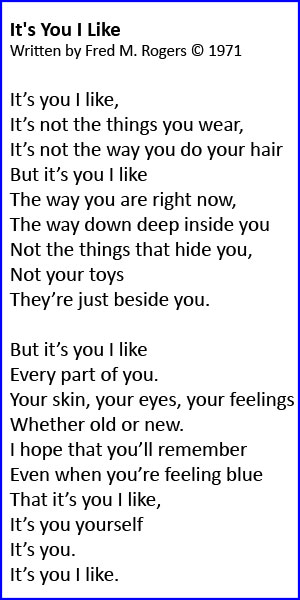
Fred wrote: “If the day ever came when we were able to accept ourselves and our children exactly as we and they are, then, I believe, we would have come very close to an ultimate understanding of what ‘good’ parenting means.”

What profound words!! Fred also wrote: “Love isn’t a state of perfect caring. It is an active noun, like struggle. To love someone is to strive to accept that person exactly the way he or she is, right here and now.”

That doesn’t mean we shouldn’t work to become better and to do better. That was axiomatic to him. But he felt we would do so more effectively, if we feel loved and accepted. This is the essence of what I have come to call asset-informed.

I believe that it is BECAUSE Fred was such an impassioned seeker of truth that he made such an impression in his lifetime and beyond.

During the time of the Saturday Night Live spoofs, Fred came to see me in my office in New York. At the time, we had a group of teenagers interning with us. These young people had struggled with serious adversity in their lives and were interning as part of a path toward healing. I had no idea how they would react to Fred since they knew more from the jokes about him on TV than from knowing him on his TV show for children. In fact, I worried. But was I wrong. When he walked in, you would have thought that the most popular rock star of the moment had entered our office. This group of seemingly tough young people flocked to him. They were awe-struck and opened up to him. He did not disappoint, then or now.

New generations continue to be raised with Fred Rogers, thanks to Daniel Tiger’s Neighborhood. My grandson would sing, “What do you do with the mad that you feel,” when he got upset as a two-year-old. The documentary about him won multiple awards, and I suspect the new film will be a big hit. We all want his type of kindness in our lives.

As for me, I knew the day I got the phone call to appear in his show that my life would change in many wonderful ways and it has. He and his team became dear friends. After his retirement, I was honored to have been asked to work with him to help plan his legacy at the Fred Rogers Center at Saint Vincent College. And I was asked to give a speech for him when he was diagnosed with stomach cancer—in case he hadn’t recovered enough to make it. Tragically, he didn’t make it and I had to give that speech. But traveling back from the speech with his team—all of us grief stricken and telling stories about the laughs we had shared with Fred, I was struck with how few leaders are loved that much from close-up, as well as from afar.

Fred Rogers has enriched our lives—those knew him in person and those who know him through his words, his songs, and his shows.

In seeking, Fred continued to find his truth. Through his seeking, generations-to-come will find Fred Rogers.

MORE:

Film Trailer: “A Beautiful Day in the Neighborhood”

Video: “It’s You I Like,” PBS

Website: Fred Rogers Center at Saint Vincent College

Website: Fred Rogers Productions

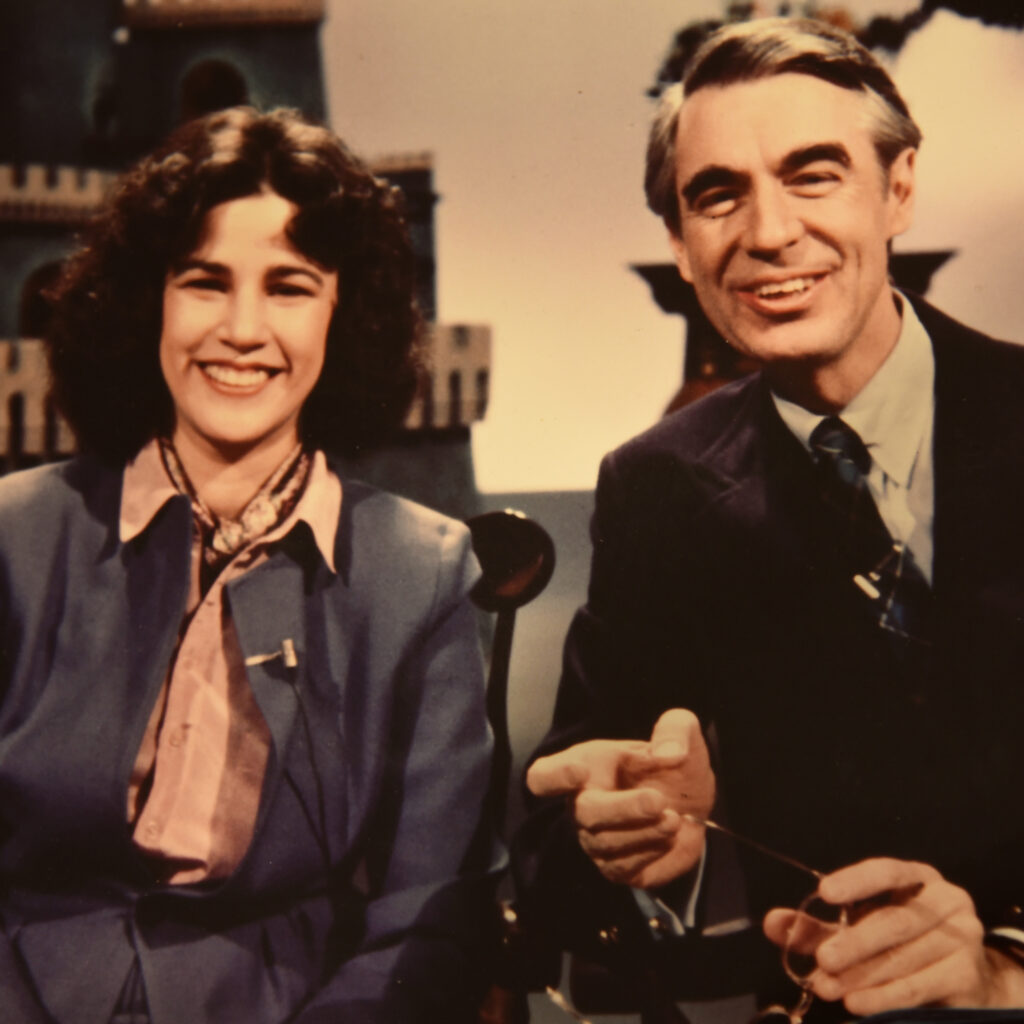
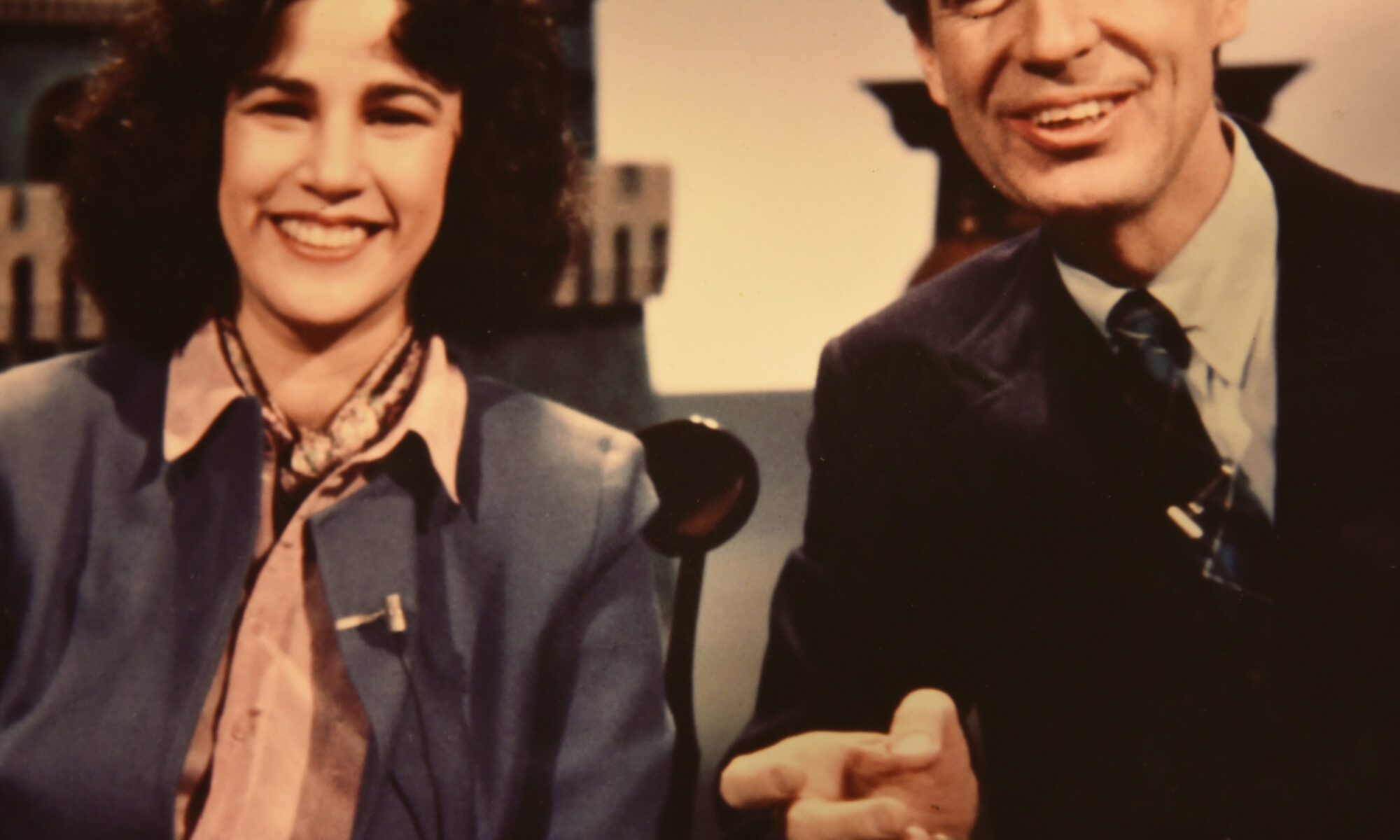
PHOTO CREDIT, FEATURED IMAGE: Ellen Galinsky and Fred Rogers circa 1980. Photo by Fred Rogers Productions

Reprinted with permission from Early Learning Nation
Why Don’t We Just Do That?

Why Don’t We Just Do That?

Three years ago, Amanda and John Horne, owners of Anna Maria Oyster Bar in Bradenton, Florida, heard that 51 percent of children in their local Manatee County school system couldn’t read at grade level by third grade. They were appalled.

“This was horrific,” Amanda says. “We had no idea that this was an issue.” Over cocktails one night, Amanda and John wondered what they could do. Their clientele is largely composed of older “grandparent-type” people. They have four restaurants and a mailing list of more than 24,000 customers. What if they could pair children up with a grandparent figure or somebody who cares about them, read with them and maybe instill them with a love of reading?

They have four restaurants and a mailing list of more than 24,000 customers. What if they could pair children up with a grandparent figure or somebody who cares about them, read with them and maybe instill them with a love of reading?

“And as the cocktails carried on, it was like, ‘Why don’t we just do that?’” she says with a laugh. Thus, in 2017, Dive Into Reading launched in partnership with the School District of Manatee County, the library system and the Suncoast Campaign for Grade-Level Reading.

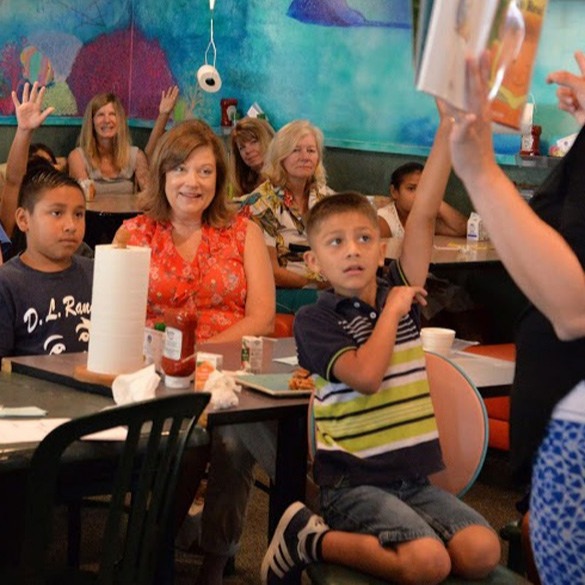
The Hornes designed the program with a simple premise: bring the children and mentors in for a hot breakfast and get them reading. Many of the children have not been exposed to basic life skills, so along with reading, they learn table manners, how to order from a menu or how to select items from a buffet.

“They come to us once a week for the four weeks of summer school and we do our best to pair them up with the same mentor every week. We want the mentors to know that it matters to the kids that an adult is actually spending two solid hours with them one-on-one.”

Amanda attended the Mind in the Making workshops offered by the SCGLR and loved learning how children’s brains work. She and John now require each mentor to attend a 1.5-hour training for which The Patterson Foundation provided two Mind in the Making trainers. The mentors have said the training makes them more comfortable with the children and confident that their interactions can actually help the children grow stronger in their ability to think and the life skills that will help them be successful.

The Hornes give each child in their program a special T-shirt that entitles them to come into any of their restaurants at any point during the next year and have a free meal. They also provide the children with gift certificates so they can bring a caregiver with them and show off what they’ve been learning. Partnering with the Early Learning Coalition of Manatee County, each of the Hornes’ restaurants now provides a book nook where the kids can read during dinner and then take a book home with them. And in partnership with other community organizations, at the end of the four-week session, each child receives a backpack filled with school supplies.

Amanda is proud of their accomplishment, which earned their restaurants the 2019 National Restaurant Association Education Foundation’s Restaurant Neighbor Award. However, in creating the program, they both have learned how much remains to be done. Many of the children face persistent hunger, for instance, and that’s not all right with the two restaurateurs. And then there are those six weeks between the end of their summer program and the beginning of school.

“What are they doing for those six weeks? I bet they aren’t reading,” she says. “We want them to be reading.”

The kids were proud and excited to receive their bracelets as rewards for reading, courtesy of the Suncoast Campaign for Grade-Level Reading “Dive Into Reading” Milestones

  • Launched in 2017 with 76 children and 54 mentors in Manatee County. After the first summer’s program, the school district tested the children and found they had gained 1.25 months of reading skill over the summer.
  • Expanded by June 2019 to all four Anna Maria Oyster Bar locations, The Bishop Museum of Science & Nature and has now expanded to Sarasota County, thanks to a partnership with Gecko’s Grill & Pub and the Sarasota County School District.
  • Communities now comprise 11 schools, seven teacher coordinators and 354 mentors who served a total of 3,487 hours to help 365 students read a total of 13,730 books.
  • Partnerships/Collaboration: The program has had support from the Kiwanis, Chamber of Commerce, school district and numerous philanthropic and service organization

RESOURCES:

Mobilizing Communities So All Children Make the Grade Pop Up Neighbor events, community, collaboration, mobilization

“Community Cultivators” Shared Values, Different Stories: Logan Smalley’s Vision for Building Community

Meeting (and Teaching) Families in Unexpected Places Grocery stores, bus stops, laundromats… what’s next?

Let’s Create An Early Learning Community Wait, What’s an Early Learning Community?

Reprinted with permission from Early Learning Nation.

Mind in the Making: 10 Years of Keeping the Fire Burning in Children’s Eyes

Mind in the Making: 10 Years of Keeping the Fire Burning in Children’s Eyes

Not all adventurers wear rugged clothes and pith helmets; some carry laptops, notebooks and pens. But all are driven by the same impulse: They have a question and they won’t rest until they have an answer that satisfies them. “What’s over that mountain?” “Where does this river go?”

In the case for Ellen Galinsky, author of more than 100 books and reports and a self-described “research adventurer,” the driving question in 2000 was, “How do we keep the fire burning in children’s eyes?”

Some people like their adventure exploring uncharted territory, Galinsky says, but for her, research into critical societal questions is the call of the wild. Twenty years ago, she was doing field research in preparation for a study on youth and learning when she discovered that while kids from the sixth through 12th grade could talk at length about “not learning,” few could talk with much passion or insight about times when they were learning.

“I interviewed incredible groups of children representing all kinds of diversity,” Galinsky says. “Children from low-income, high-income and middle-income families, from public and private schools, charter schools, living in inner cities, suburbs, rural areas. Across the board, few of them had a real excitement about learning. There weren’t really engaged in learning.”

Knowing that babies are born learning—wanting to see, to taste, to touch, to explore their worlds—Galinsky was haunted by the question, “What happened to that fire?”

For 10 years, she and her colleagues, including award-winning filmmakers from New Screen Concepts, pursued that inquiry by interviewing and filming leading child development researchers. After a few years, she began to see common threads not only in what sapped children’s engagement in learning, but also in the elements that fostered it. These findings were called by different names in different fields, but Galinsky’s training as a researcher and passion for conducting studies led her to recognize unmistakable patterns.

Out of her analysis of the work of nearly 100 researchers, she saw the importance of the “how of learning”—how a certain set of brain functions help people thrive and learn. The even better news she observed is that these brain functions (called executive functions) involve skills that can be developed and nurtured.

In 2010, this inquiry became a pioneering book—”Mind in the Making: The Seven Essential Life Skills Every Child Needs”—that has become a staple for teachers, parents, pediatricians and anyone with a personal interest in early childhood. As Drs. Spock and T. Berry Brazelton were to previous generations, Galinsky’s “Mind in the Making” is a seminal resource for those wanting to see children do well in the world.

The engine of “Mind in the Making’s” success is not only its rock-solid research, but its conversational, relatable language, filled with storytelling, individual examples and questions designed to provoke thought and discussion. Galinsky’s foundation as a teacher and educator (25 years on the faculty of the prestigious Bank Street College of Education before co-founding Families and Work Institute) shows in her personable, playful approach to the information, written in a way that doesn’t guilt-trip families and professionals but leads them into a thoughtful consideration of the ideas she’s presenting.

While Galinsky might have paused to take a deep, relieved breath once she had finished writing the book, she knew this was the starting point, not the finish line.

“Even after the decade of research, it takes nine months to birth a book,” she says. “After I got through the nitty gritty part of writing and with my colleagues, checking, double-checking and triple-checking the footnotes and quotes, I sent the manuscript out to 20 to 30 people I really admired. I was terrified, totally terrified, because I had taken their research and woven it into a larger theory and I worried that they might not like it. But I also wanted to figure out with them and others how we could turn this theory and the research behind it into action.”

To her great relief, the responses were “incredibly positive.” From that starting point, “Mind in the Making” became as much a movement as a book.

“I didn’t want this to be a book that just sat on the shelf,” Galinsky says. “I wanted the knowledge to be useful and usable for people. I wanted to put forth a common language that people could use to understand behavior in systematic ways. And I wanted this to be knowledge people could act on.”

Take a Deep Dive into MITM!

“As soon as the book was published, my colleagues and I were doing 100 things with ‘Mind in the Making,’” she says. “At Families and Work Institute (the non-profit she co-founded in 1989), we raised funds from 23 foundations to create materials—a series of videos called Experiments in Children’s Learning, Book Tips in partnership with First Book and Skill Building Opportunities—tip sheets on turning discipline issues into opportunities to promote life skills. With funds from the Kellogg Foundation and others, we developed learning modules for community leaders and then with additional funding, adapted them for museum and library educators and for healthcare professionals. We also gave small grants to people in communities all over the country who were already using Mind in the Making for projects to expand their impact.”

In 2016, Mind in the Making became a program of the Bezos Family Foundation to share the science of children’s learning even further through in-depth training and action-oriented materials. At the Foundation, where Galinsky served as Chief Science Officer, the Mind in the Making team—including Erin Ramsey, Jennie Portnof, Marline Griffith and Brandon Almy—continued to create new materials. Importantly, they created online Modules with Cultivate Learning at the University of Washington.

Galinsky says the dog-eared, scribbled on copies of her book, filled with Post-Its and marginalia make her happy. “It feels as if the reader and I have had a conversation. She continues, “When you write a book, it’s a very solitary activity. It doesn’t take a quarantine to quarantine anyone who’s writing a book. So, seeing the way people are actually using the book is gratifying. And the fact that we’ve reached the 10th anniversary is simply incredible to me.”

Significant Impact: Getting the Science off the Shelf and Into the Hands of Users

One of the first big impacts of the book was that the National Association for the Education of Young Children obtained the rights to publish 25,000 copies of “Mind in the Making” for teachers. A second big impact was a partnership with the Institute for Educational Leadership in implementing training and sharing materials with community schools in six different parts of the country.

“Teachers and principals don’t necessarily learn child development information,” she says. “They learn a lot about pedagogy (the principles and methods of instruction), but they learn less about child development. And they want that—they want to know why children act and develop the way they do. So, we found this huge resonance for ‘Mind in the Making’ in schools.”

“There are wonderful repercussions of our work with community schools,” she says. One repercussion was meeting Erin Ramsey who had been overseeing the Mind in the Making work in Evansville, IN. Ramsey joined the Mind in the Making team in 2012. “Erin is one of the most talented trainers and materials-creators I have ever met,“ says Galinsky.

Ready to Learn Providence

Another repercussion was a U.S. Department of Education’s Investing in Innovation grant to Ready to Learn Providence that expanded their community school work. Through this grant, Ready to Learn brought Mind in the Making, (which they describe as “a powerful learning experience for adults about how young children develop executive function skills”) to all 22 elementary schools in Providence, training close to 2000 mothers, fathers, grandparents and other family members, and more than 400 professionals.

“Mind in the Making was a transformative experience for so many members of the Providence school community,” says Leslie Gell, Director of Ready to Learn Providence. “Over our four-year project, external evaluators found that families reported significantly less authoritarian views toward parenting, which research shows leads to higher executive function skills in children. They also found that parents reported more positive views about the importance of their involvement in the schools, expressed more confidence in their ability to help and support their children in school, and reported growth in the social, emotional and cognitive development of their children.”

Mount Sinai Parenting Center

In 2019, the Mount Sinai Parenting Center in NYC, in collaboration with the Mind in the Making team, released Keystones of Development Curriculum, a curriculum they had worked on together for a number of years. This online curriculum for pediatric residents shows how to promote brain development and strengthen parent-child relationships within routine well-child visits. Dr. Carrie Quinn, Executive Director of the Mount Sinai Parenting Center, just announced that 101 programs, 2800 residents, 641 faculty members and 298 champions are now enrolled—reaching almost half of all of the pediatric residency programs in the United States!

National Head Start Association

The Mind in the Making and Vroom teams at the Bezos Family Foundation are especially proud of their collaboration with the National Head Start Start Association. “We have a dream of creating a Mind in the Making Nation,” says Yasmina Vinci, executive director of the National Head Start Association. “In Head Start’s 55th year of getting children ready for school and life, we will accelerate and scale the awareness and impact of strategies for promoting executive functioning among Head Start’s more than 270,000 staff members across 1,600 grantees in communities across the country.”

Ellen Galinsky discusses how a focus on “trauma informed care” in early learning is shifting to “asset informed care.” And that process starts with looking at children in terms of their strengths.

In looking at her own growth over her years of researching and writing “Mind in the Making,” Galinsky says delving into the research itself was full of surprises and questions leading to more questions. She was especially captivated by the fact that babies’ brains appear to be wired to help them to learn about the world in specific ways, and that this learning begins long before babies can be taught this kind of knowledge.

In “Mind in the Making,” Galinsky wrote, “babies’ capacities are truly amazing, but even more amazing is that we now know how to take advantage of these capacities to help babies and their older siblings develop the essential life skills to serve them throughout their lives.” And that’s what Galinsky and the Mind in the Making team are so proudly doing, day in and day out at the Bezos Family Foundation.

Even as Mind in the Making celebrates its 10th anniversary and continues to expand society’s knowledge base about young children’s behavior and development, more questions have introduced themselves to Galinsky’s inquiring mind.

“I’m continuing to pursue questions related to ‘Mind in the Making,’” she says. “But my big adventure now has been looking at adolescent development, including conducting several studies of adolescents and their parents. In addition, through the Bezos Family Foundation, I’ve gone out with filmmakers Lisa Rinehart and Jennifer Hamblett and filmed more than 35 leading researchers on adolescents’ development around the world.”

Galinsky is currently writing a book about adolescence and hopes to create all kinds of resources, including materials to help adolescents understand their own development. She says, “I feel that I am unlocking new knowledge of how to help adolescents and the adults in their lives thrive.“

A worthy pursuit for Ellen Galinsky, adventure researcher—and the adolescents, parents, educators and others whose lives will be altered by this handiwork.

MITM: Creating Cultural Ripples of Early Learning + Brain Building

Researcher and author Ellen Galinsky likens the aftereffects of publishing a book to the ripples created by tossing a rock in a still lake. The size of the rock determines how far the ripples will reach. In the case of her “Mind in the Making: The Seven Essential Life Skills Every Child Needs,” it was mighty big rock.

  • Since Mind in the Making launched in 2010, more than 100,000 people in communities across the U.S. have participated in its training and learning modules. A survey of 1,750 respondents who attended the trainings revealed that 98 percent reported that the experience helped them improve their skills with children and learn new approaches and knowledge.
  • The MITM team has reviewed more than 2,000 studies and interviewed and filmed more than 160 leading researchers, incorporating their work in MITM training and tools
  • MITM has offered more than 300 presentations to national, state and community groups interested in education, workforce development, parenting and brain science; a half-million+ readers have downloaded MITM’s more than 100 free resources that help bridge the gap between knowledge and practice.
  • Vroom is a global program of the Bezos Family Foundation that offers free, science-based tips and tools to help caregivers and parents give children a great start in life. Communities, organizations, brands and media have worked together to reach parents where they are: community-based health clinics, refugee camps, children’s museums and other essential settings. These free tools that the Mind in the Making team helped create are offered in English and Spanish, and show how little changes can make a big impact on growing brains.
  • To see how MITM has been at the center of magical mind-building events and programs, see Early Learning Nation’s extensive examples.

Ellen Galinsky discusses how a focus on “trauma informed care” in early learning is shifting to “asset informed care.” And that process starts with looking at children in terms of their strengths.

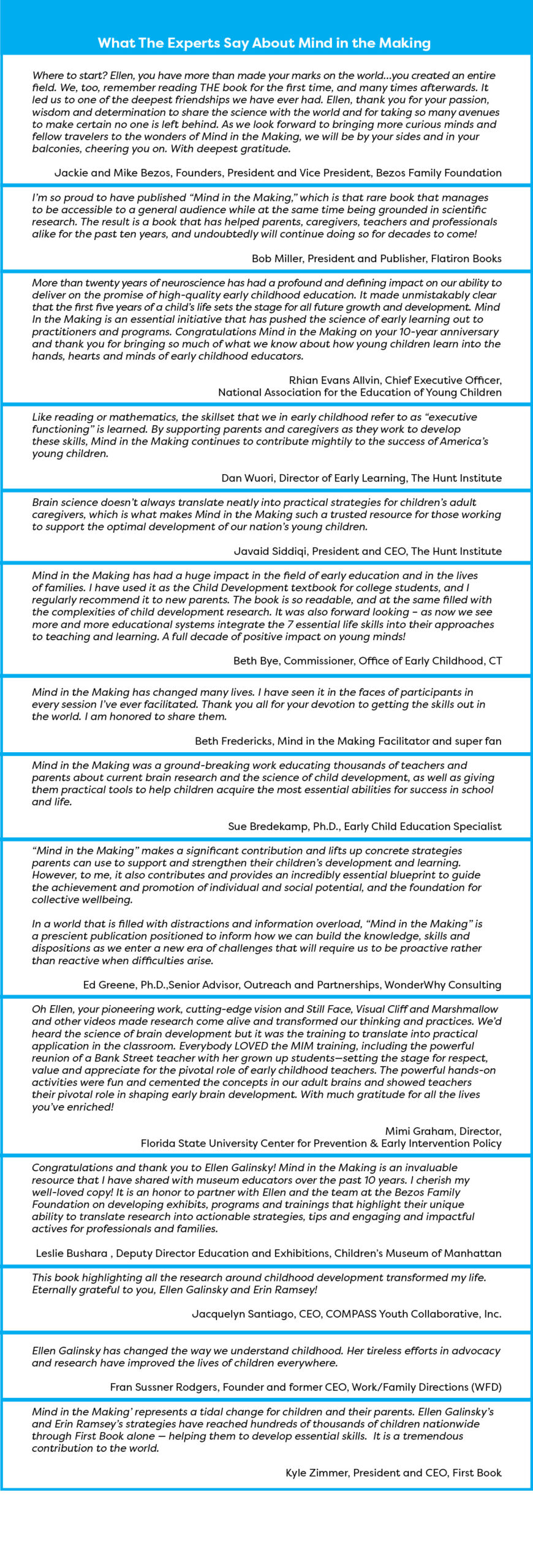
What The Experts Say About Mind in the Making

Reprinted from Early Learning Nation
Child Care vs. School/Education vs. Care

Child Care vs. School/Education vs. Care

The divide between how school is currently seen (as education) and child care is seen (as caring at best and as warehousing at worst) is not only infuriating, it is just plain wrong. What’s worse, it could take us back 40 years.

This backwards turn ignores the decades of research revealing that the early years are foundational to learning. It also ignores the decades of research revealing that children need both education and care when they are infants, toddlers and preschoolers, and when they are school-aged and older.

This is not a semantic argument. It is creating draconian decisions policy makers, educators, and families have to make. For families, it’s trying to stay safe, having your children learn and earn a living when in-person child care may be open but in-person school is not and you have different children in different places on different days of the week and your job is lost or in jeopardy. For teachers, it is trying to stay safe, trying to teach when children may not have connectivity or learn well online and your own child’s care is a house of cards. For programs and policy makers, it is trying to stay open or being forced to close because there isn’t enough money. And for everyone, it is ongoing uncertainty and fear.

Thank you, Elliot Haspel—author of Crawling Behind: America’s Childcare Crisis and How to Fix It—for your eloquence and perfect timing for this OpEd. He highlights “the duality of the conversations around child cares programs and public schools and the perceived gap between what “care” and “education” mean. That gap has set the two sectors on different paths of funding, governance and professional power.” in “Why Are Child Cares Open When Schools Are Not?” and the even more explicit lead-in “Society’s perception of child care being of lesser quality to education has rarely been so pronounced” for The New York Times.

If ever there was a time to try to heal schisms, this is it!

Mind in the Making is Joining Families & Work Institute

Mind in the Making is Joining Families & Work Institute

A Letter from Ellen Galinsky, Founder of Mind in the Making:

On September 30, 2022, Mind in the Making is joining Families and Work Institute (FWI).

Given the pandemic and rapidly changing landscape, this move presents an important opportunity both for the MITM team and me personally to take on new research on the major issues of our times as well as on early childhood and youth voice.

The transition to FWI—a nonprofit, non-partisan research organization and think tank I co-founded in 1989 to focus on the changing workforce/workplace and changing families and their children—will also allow me to expand my own research projects around civic science.

One of the first endeavors is a partnership with the University of Minnesota. Starting in fall 2022, I will serve as co-director of a forthcoming Civic Science Center alongside Philip David Zelazo, PhD, Nancy M. and John E. Lindahl Professor, Institute of Child Development, University of Minnesota. The new Center aims to be the “go to” place for understanding and promoting the development of executive function skills and related essential life skills in children, adolescents, parents and practitioners who work with them.

“Ellen Galinsky has a distinguished history of working directly with communities to address some of society’s most pressing problems,” said Zelazo. “Together we will coordinate research, policy and practices to close opportunity and achievement gaps by helping children and youth succeed in school and in life.”

I am proud of the work we’ve accomplished during the past six years at the Bezos Family Foundation. Our team forged new state and national partnerships to share the science of early learning, created new actionable resources to promote executive function-based life skills within children and adults and developed soon-to-be-released digital learning modules that will greatly increase the accessibility of our early childhood training.

As Mike Bezos, Vice President of the Bezos Family Foundation shared, “Ellen Galinsky and the entire MITM team have been valuable contributors to our investments in the science of learning and the experiences that youth need to thrive. The Foundation remains as committed as ever to fueling and amplifying research. We look forward to exploring opportunities to work together with MITM in the future where our individual missions intersect.”

Please stay updated on our work as it evolves by following us on Facebook and Twitter!

With gratitude,

Ellen

Author, Mind in the Making and The Breakthrough Years (forthcoming)

Mind in the Making and Amazing Babies

Mind in the Making and Amazing Babies

An Exercise: What Is Life Like Today? Think about some words that describe what life is like today. What words come to mind?

Did your words reflect the challenges of living in a complicated, distracting world? Did you think of words that describe feelings of being rushed, time starved, of having too much to do and not enough time to do it? Did you focus on the uncertainties, the changes that ricochet in our economic systems, or the volatility of relationships in a diverse and unpredictable world? Did you focus on the moments that give you pleasure, large and small?

Life today can be all of these things—complex, distracting, fast moving, 24-7, and stressful. It is also joyful and full of exciting possibilities.

We know that if it is this way for us, it is only going to be more so for our children. We all want the best for our children, but how do we help them not only survive but thrive, today and in the future?

It is clear that there is information children need to learn—facts, figures, concepts, insights, and understandings. But we have neglected something that is equally essential—children need life skills.

What do I mean by skills? Take the words often used to describe the world: complicated, distracting. Or the words about time: 24-7, rushed, time starved, too much to do and not enough time to do it. To navigate this world, children need to focus, to determine what is important and to pay attention to this, amid many distractions. Focus is one of the essential skills we need to promote in our children.

Or take the words used to describe the complexity of life in an uncertain, even volatile world. Another essential skill is the ability to understand others’ perspectives—perspective taking—despite whether we end up agreeing or disagreeing with them.

There are three essential points about these life skills:

  1. These skills are not only important for children; we as adults need them just as much as children do. And, in fact, we have to practice them ourselves to promote them in our children. That’s why I call them life skills.
  2. We don’t need expensive programs, materials, or equipment to promote these skills. We can promote them in everyday ways through the everyday fun things we do with children.
  3. It is never too late to help children learn these life skills, no matter what their ages.

So many books for parents make us feel guilty or that we have made mistakes. Mind in the Making is not a guilt trip but a way that helps us understand children’s development in new ways, with hundreds of to-do suggestions. These are the conclusions I have drawn from my own research, from spending more than eight years interviewing more than seventy researchers on children, and from reading more than a thousand studies to write Mind in the Making.

Amazing Babies

One theme from the research on children and learning is that babies’ brains appear to be wired to help them understand and know about the world in specific ways, and that this learning begins long before babies can be taught this kind of knowledge. Babies four months short of their first birthdays already have what I call a language sense: they can detect statistical patterns in which sounds go together in their native language (or languages) to determine the beginnings and endings of words in a “sea of sounds,” as the studies of Jenny Saffran of the University of Wisconsin show.

Since babies that young can’t talk, how can researchers possibly know this? Babies—like all of us—are drawn to anything new. So the researcher gives babies something to listen to or look at that is new to them and they look or listen until they get bored. At that point, the researcher presents them with other things to listen to or look at and can tell from the babies’ reactions which things the babies view as new (measured by longer listening or looking times) and which they see as familiar (measured by shorter listening or looking times).

So when Jenny Saffran and her colleagues presented babies with a made-up language and, in subsequent studies, with a language they didn’t know, they found that babies seem to use an almost statistical-like process to learn that certain sounds are likely to follow other sounds in that language.

As a result, the babies became bored with and stopped listening to the made-up or the unfamiliar language after a while, but showed renewed interest when they were presented with new combinations of sounds.

Similar studies have shown that infants six months old and even younger have a number sense: they can detect the difference between large and small numbers of things—such as the difference between eight and sixteen dots, or the difference between a large and a small number of times that a puppet jumps or a car honks its horn, as seen in the studies of Elizabeth Spelke and her colleagues of Harvard University.

And they have what I call a people sense: they focus on people’s intentions rather than seeing what people do as random movements in space, as shown by the studies of Amanda Woodward of the University of Maryland. By six months, they can tell the difference between who’s helpful and who’s not, which Kiley Hamlin, Karen Wynn, and Paul Bloom of Yale demonstrate by showing the children a puppetlike show where a round circle with big eyes tries to reach the top of a hill and is helped up to the top by a square but pushed down the hill by a triangle.

After the children view the show, an experimenter who doesn’t know what has happened in the experiment (so as not to influence the babies) enters and places the triangle and the square on a tray in front of the baby to see which one he or she reaches for. Will the six-month-old reach for the character that helped the circle achieve its goal (the helper) or the character that prevented the circle from achieving its goal (the hinderer), or is there no pattern to the babies’ choices? Of course, the researchers sometimes used the triangle as the helper and the square as the hinderer.

Hamlin says:

We found impressively that almost one hundred percent of the babies in a number of different studies preferred the more positive character. 

Yes, babies’ capacities are truly amazing, but even more amazing is that we now know how to take advantage of these capacities to help babies and their older sisters and brothers develop the essential life skills that will serve them throughout their lives.

©2023 Mind in the Making

Praising Children

Praising Children

Praising Children

Question: I have read that praising my child is important for her self-esteem, but then I have also read that too much praise can spoil my child. I’m confused. How should I praise my child?

Kids are amazing and it’s easy to find ways to authentically praise your child while, at the same time, promote the life skill of Taking on Challenges.

Taking on Challenges: Life is full of stresses and challenges. Children who are willing to take on challenges (instead of avoiding them or simply coping with them) do better in school and in life.

We typically think that children who are praised a lot will feel better about themselves, but this is not necessarily true. It’s how we praise children that matters. Carol Dweck of Stanford University found that adults who praise children for their personality (“you are smart” or “you are so talented”) develop what she calls a fixed mindset. They begin to believe that these characteristics are inborn and can’t be changed.

As a result, they want to hold onto these labels and then become less willing to try things that are hard, where they might not seem as smart. On the other hand, children who are praised for their effort (“you tried so hard”) or their strategies (“you figured out how to put on your sock by yourself”), develop a growth mindset, where they see their abilities and intelligence as something that can be changed.

Children who hold a growth mindset are more likely to try really hard in the face of challenges.

Praise effort and strategies, not intelligence or personality. Rather than praising your child’s personality or intelligence (“You’re so ‘artistic’ or ‘athletic’”), criticizing him or her (“You’re lazy”), or attributing their accomplishments to luck, instead praise your child’s efforts or strategies. When your child sees that she or he can try and learn something new, your child will learn to feel good about herself.

Help your daughter set her own challenging goals and to work toward them. Taking on Challenges includes believing that we can do things even when they are hard. Encouraging her when she’s working hard toward meaningful goals is important. It’s best not to praise your child all of the time for everything because the praise becomes less special and thus has less impact. Children will learn to work diligently on a goal when they are intrinsically motivated rather than doing something for approval.

1. Be a role model and promote curiosity.

Set goals and work toward them and share your experiences, strategies and feelings about the process with your child. It’s important to share why you are working toward the goals (personal satisfaction, new knowledge, etc.) so your child can see that praise is not the reward, but rather, the experience and process.

The American Academy of Pediatrics suggests the importance of setting appropriate expectations for success.

2. Set appropriate expectations.

Setting expectations for goals that are not too low or too high is critical to developing competence and confidence. If you are overprotecting your child, and she is too dependent on you, or if expectations are so high she’ll never can succeed, she may feel powerless and incapable of controlling the circumstances in her life.

3. Help your child find ways to contribute.

Self-esteem is a key feature of leading a fulfilling life. Children develop a positive 
sense of self if they think they’re making a contribution. Help your child find things to 
do that makes her feel good, like taking care of the dog or making a card for someone who feels sick.

©2023 Mind in the Making

Helping Children to Learn to Take on Challenges: Lessons from Heidelise Als

Helping Children to Learn to Take on Challenges: Lessons from Heidelise Als

I’m writing about is Heidelise Als of Harvard University, because her studies are so instructive in how we can help children deal with challenges and learn to become stronger as a result.

Perhaps surprisingly, learning this skill doesn’t just happen when children are older. Als’ research is with pre-term babies born 10 to 12 weeks before their due date—the most fragile babies in neonatal intensive care units. When adults watch what young children do to cope successfully and then create situations where they can do more of the same, the process for learning to take on challenges is seeded.

The insight that led to Als’ research began in her native Germany when she was as a teacher of 3rd grade boys. One of the boys, Reinhart, always came to school early, sat in his seat close to the front of the classroom, lined up all of his pencils and books on the desk and was ready for the day to begin. Since Reinhart was doing very well and got good grades, Als decided to move him farther back in the room so another child who needed extra help could have a seat in the front.

She says:

Reinhart moved promptly, yet the next day he didn’t come in. He had never missed a day of school. I was very concerned. He didn’t come the next day.

After a few days, Als stopped by the bakery Reinhart’s family ran. His mother told her that the doctor couldn’t find anything wrong, but her son had been vomiting. The clue came when Reinhart’s mother mentioned, “He did tell me you moved his seat, and he’s now sitting farther back.” Als says:

I learned from that that despite seeing the image of a very competent child, I should have known from his need to have everything lined up at the start of the school day—that he didn’t have the flexibility that other children had.

Reinhart was given his old seat back when he returned to school, but Als gained even more from that experience. She learned how important it is to “read” the language of children’s behavior, to figure out how they cope best and then build on their own positive coping strategies. This lesson was reinforced after she moved to the U.S. to attend graduate school and had her own child, who is significantly brain damaged. She had to learn to understand the language of his behavior in order to help him.

Als brought that sensitivity into her research on premature babies. Through advances in technology in the 1970s, these babies, who couldn’t yet breathe on their own, could be kept alive with medical ventilators that, in effect, breathed for them. What really interested Als was “to see what these babies were up against” and how they were handling these stressful situations.

As she observed them, it became clear to her that good medical care was coming at the price of good developmental care:

The premature babies would be pinned down, held down, strapped down, and even chemically treated, if needed, so that they would not breathe against the ventilator in order to let the ventilator do the work that it needed to do.

A similar kind of scene took place when a nurse or doctor wanted to check on a baby, listen to the baby’s heart rate or change him or her: The baby would just splay out—all four limbs would fly out, and then the baby would try to grasp at something, but the nurse by then would already be putting her stethoscope on the chest, listening to the chest sounds. And then she would turn the baby over again and listen to the back, and then she would start to suction his lungs and then she would give a nebulizer treatment.

As the check-up progressed, Als reports, babies would become more and more distraught; finally, they would “go limp and typically stop breathing.” It was clear to Heidelise Als that the medical care was so focused on caring for these premature babies’ hearts or lungs that they were neglecting the care of the whole child:

It seemed we were wasting a lot of the baby’s energies that were very precious. We were going against the baby. We were pushing the baby to become exhausted and give in.

When a baby who was initially feisty gave in, the medical charts would record that the baby had become well adjusted. But Als saw a different reality:

The baby had given up. The baby just let the world happen.

Als and her colleagues—nurses and doctors—set out to improve developmental care and to document that it can make a difference. They thought of this as listening to their behavioral “language.” She says:

If we can understand the ‘words’ the baby is saying, maybe we can fill in the meaning of the sentence and understand the message.

These observations led to solutions. For example, if the baby’s hands splay out, give the baby something to hold onto. If the baby is squirming under the bright lights, make the lighting softer. If the baby is getting agitated, hold the baby until his or her breathing becomes more stable. After documenting and recording behavior, they launched into a study where the nurses “read” and then responded to the baby’s behavior in ways that built on that baby’s coping strategies, and thus gave the baby more control.

The results of this experiment were impressive. There was reduced severity of chronic lung disease in these premature babies, improved brain functioning, improved growth and earlier release from the hospital. In addition, their care was significantly less costly.

Here’s the lesson I take from this. Children, even those as young as premature infants, are less prone to the harmful effects of stress when they are supported in managing their own stress by being helped to use the strategies they have for coping and for calming down.

And when children are older, they can become an even more active part of figuring out themselves how to deal with tough times. Als tells the story of a child for whom any reminders of 9/11 (like fire trucks) would trigger emotionally flooding. With the help of adults, he created his own strategy to calm down. He would put his head down on the table to “think” and would wait until he had “thought enough”—and then he was ready to go on.

From these studies, it is clear that we can help children learn to handle tough times if we enable them to become increasingly active partners in creating their own solutions. It has worked for me and it has worked for my children. What about you?

This story is taken from Mind in the Making.

Focus and Self Control . . . Maybe as Important as IQ

Focus and Self Control . . . Maybe as Important as IQ

Focus and Self Control . . . Maybe as Important as IQ

Jeanne Brooks-Gunn of Columbia University and a group of other academics reviewed six studies that followed children over time, offering a rare opportunity to evaluate what kinds of skills or knowledge acquired early in life matter most to children’s later success. They compared children’s school achievement in math and reading between the ages of eight and thirteen to assessments of these same children when they were between ages four and six.

What did they conclude? Out of literally hundreds of analyses, only three skills that children had when they entered school were strongly related to their later success in reading and math. Two are obvious: the children who had good math and reading skills when they entered school had good math and reading skills years later.

But the third skill is less obvious. It was attention skills—the more penetrating our attention, the richer and deeper our learning. As Brooks-Gunn says:

Attention skills allow children to focus on something in a way that maximizes the information they get out of it.

Adele Diamond of the University of British Columbia has been a pioneer in studying what scientists call the executive functions of the brain—because these are the brain functions we use to manage our attention, our emotions, and our behavior in pursuit of our goals. She believes that executive functions predict children’s success as well as—if not better than—IQ tests:

Executive functions are different than what people usually think of when they think of IQ. Typical traditional IQ tests measure what’s called crystallized intelligence, which is mostly your recall of what you’ve already learned—like what’s the meaning of this word, or what’s the capital of that country? What executive functions tap is your ability to use what you already know—to be creative with it, to problem-solve with it—so it’s very related to fluid intelligence, because that requires reasoning and using information. There’s a big overlap between fluid intelligence and executive functions.

Executive functions, which emerge during the preschool years and don’t fully mature until early adulthood, appear to have a bearing on school success, too:

If you look at what predicts how well children will do later in school, more and more evidence is showing that executive functions—working memory and inhibition—actually predict success better than IQ tests.

Philip David Zelazo of the University of Minnesota, also a leading researcher studying executive functions of the brain, sees more of an overlap between IQ and executive functions. For example, we might not do well on an IQ test because we’re distracted and can’t pay attention. Also, having a good working memory matters in both IQ and executive functions. Like Diamond, Zelazo notes that executive functions enable us to use our knowledge:

If you ask what is the difference between these two constructs, I think it would be that it is possible to have knowledge of what one’s supposed to do—but for various reasons to have difficulty acting in light of that knowledge.

Executive functions take place in the prefrontal cortex of the brain. I love the term that Stanislas Dehaene uses to describe this part of the brain—a global neuronal workspace:

It’s a theoretical construct, but the human brain contains a set of areas that are much more tightly interconnected to each other—like hubs in airports.

The prefrontal cortex is responsible for the ability to exchange information across the high-level areas of the brain, Dehaene says, so that our behavior can be guided by our accumulated knowledge.

That’s the beauty and the purpose of executive functions: they enable us to control ourselves, to reflect deeply, and to consider things from multiple points of view.

Perspective Taking: Reducing Conflict in Children: Lessons from Larry Aber

Perspective Taking: Reducing Conflict in Children: Lessons from Larry Aber

J. Lawrence (Larry) Aber’s studies provide important insights into reducing conflict and aggression in children, an issue of great importance in our conflict-laden world. But I am also sharing his story because it illustrates the principle that in research—as in life—there can be many missteps before the right path is found.

In fact, this is one of the things that I most love about conducting research myself: it is an adventure. Like scaling a mountain peak or kayaking in rough waters, the researcher sets out on a journey, armed with experience and knowledge, but never fully knowing what he or she might find. Sometimes the path is clear, but usually it’s fraught with uncertainty, unexpected challenges, and wrong turns.

The experiences of Larry Aber of New York University illustrate this point. In studying aggression in children, Larry Aber had findings from his and others’ research, but they weren’t very strong findings. So he too kept looking.

Aber has been especially interested in aggression in younger children because it can escalate into greater aggression during the teen and adult years—and interfere with children’s learning. He wanted to know: What are the roots of aggression in children? When in a child’s life is aggression likely to flare up? Does it continue to escalate or can it be prevented, and if so, how? In other words, can more constructive ways of dealing with conflict be taught? He says:

Children who get in fights with other children, children who disobey—who are constantly in conflict with other children and teachers—are on a path where they’re not learning now and they’re going to learn less in the future.

The focus of the early research was that children who were aggressive simply hadn’t learned constructive ways to solve problems. As Aber says: When one child pushes another, the early thinking was that children who responded aggressively to that push had an impoverished repertoire of options—they only knew how to push back or to push harder.

As a result, there were 20 years of attempts to improve children’s “repertoire” of problem-solving skills. Did these efforts yield results? Yes, but “only a little bit,” according to Aber. So the question became why.

Building on the prior laboratory work of Kenneth Dodge, Aber and his colleagues began to investigate what goes on in children’s minds when they are provoked. To do so, they asked children how they would respond to ambiguous hypothetical situations—such as one child bumping into another in a school cafeteria and spilling a drink on the second child. Which children would decide to push back harder? And which children would decide to use other problem-solving skills, and why?

They discovered a missing link, a link they call an “appraisal process.” In the spilled-drink scenario above, for example, the child who has been bumped makes an immediate assessment of the situation, such as: Maybe this kid doesn’t like me? Maybe this kid is trying to hurt me? For the children who assume that others are out to get them, having skills to handle conflict are relatively worthless. They have what researchers call “a hostile attribution bias.” These words are a mouthful, but what they mean is that some children immediately interpret ambiguous situations as hostile. When there isn’t enough information to be certain, they jump to conclusions.

Given this insight, efforts to curb aggression in children of all ages have moved to include what Larry Aber calls “attributional retraining;” that is, helping children step back when something happens to them and make sense of the situation. Teachers using this approach help children gain perspective on the situation, to realize that they don’t have enough information to know why they were bumped, and to look for clues to understand whether this was an accident or a hostile act.

Larry Aber and his colleagues have experimented with how teachers can teach appraisal skills in order to reduce aggression. Their research holds many lessons.

In their first studies, they followed children from the first through the sixth grades in the New York City public schools. They picked this period in childhood because they’ve found that aggression can escalate during this time. Initially, they evaluated a curriculum called the Resolving Conflict Creatively Program (RCCP), developed by Educators for Social Responsibility. This curriculum teaches children appraisal skills—how to figure out someone else’s intention. It also shows children that they have choices about how they handle conflict and gives them skills for making those choices in their everyday lives. Not surprisingly, Aber found that the more RCCP lessons children were taught, the more competently they handled conflict.

But Aber suspected that the results could be even stronger, so they began work on a second series of evaluation studies in the New York public schools with a successor program to RCCP called the 4 Rs Program—Reading, Writing, Respect and Resolution. This program doesn’t separate teaching children to handle conflict from other kinds of academic teaching; it combines what I see as social, emotional and intellectual (SEI) skills. Each unit is based on a children’s book selected for its literary quality and its relevance to the theme.

Through discussions, writing exercises and role-play, children explore the meaning of the book, learn how to appraise complex situations and then are taught how to resolve conflicts in these situations.

The early results of this research are even more promising. Children are less likely to jump to conclusions about others’ behavior. Their mental health is better. And the reading scores for those who initially showed the most substantial behavioral problems have improved.

Aber’s research further confirms that children need to learn how to figure out the intent and perspectives of others when they’re in conflicts. Once you’ve helped children do that, as he puts it, “you’ve opened the gate to them using problem-solving skills—that also needed to be developed.” He says: “That is an issue of learning; it is not just a side affair. That affects the environment in which children learn.”

This story is taken from Mind in the Making.

Interested in Mind In The Making Training?

Find out more!

Your support will allow us to continue to deliver our high-quality research, publications, and services to you. Families and Work Institute is registered as a 503(c)(3) non profit organization
EIN 13-3560042.

To provide a Corporate Gift or have Donation questions – Please email donate@familiesandwork.org