
When to Teach Letters, Colors and Numbers to Babie

When to Teach Letters, Colors and Numbers to Babie

When should I start teaching letters, colors and numbers to my nine-month-old daughter?

First of all, what a wondrous time! Children are born learning and, in these early years, you are laying the foundation for their lifelong learning.

Noting that the brain grows from one pound to its full size in the first five to six years of life, neuroscientist Sam Wang of Princeton University compares brain development to building a house:

A baby’s brain is like a house that’s being built. If you think about all the things that babies have happen to them—we feed them, we love them, we talk to them, they have other experiences with other kids, whatever it is that they encounter—all of those are learning experiences. So, there’s this constant construction project where babies and small children are putting together the basic foundations for who they are going to become later.

Because babies learn so much in these early years—with 700 trillion connections among the neurons in the brain being formed during that time—you’re not alone in wondering when and how to teach kids about letters, colors and numbers.

Even very young children can learn to memorize the names of numbers, letters and colors. What’s important is that they don’t just memorize the words, which they may do to please adults, with little to no understanding of what these concepts mean. When you use everyday moments to help children understand the concepts of colors, letters and numbers, they learn what these ideas mean, and they learn the life skill of Making Connections.

Making Connections is at the heart of learning—figuring out what’s the same and what’s different—and sorting these things into categories. Making unusual connections is at the core of creativity. In a world where people can “Google” information, people who can see connections are able to go beyond knowing information to using this information well.

Be a partner in your child’s explorations and play.

During the early years, kids learn by touching, tasting and playing with everything around them. Get involved, but let your child take the lead in choosing activities and objects that interest her. Instead of taking over or telling your child what to do, be a guide.

Roberta Golinkoff of the University of Delaware and Kathy Hirsh-Pasek of Temple University have found that children learn more when their parents are involved in what they do:

When a parent joins in, we call it “guided play,” and it always elevates the level of play. So, parents shouldn’t feel like they have to stay out and let the kids play on their own—they should join in, but they can’t be the boss. They have to follow the child’s lead and talk about the kind of things that the child is interested in.

This is where you can add concepts naturally, such as letters, colors and numbers. For example, you can say:

  • “You are playing with the yellow duck in the bath.”
  • “I gave you two pieces of banana.”

Even though your child at nine months is just making sounds as a step into learning to talk, she hears and increasingly understands what you are saying. Over time, she will begin to understand these and other more abstract concepts.

Build on your child’s interests.

Sam Wang states that the key to learning is play.

Play is where active learning takes place—where the baby is engaged or the child is engaged and just wants more and more of that. As long as that element of fun and play are present, then that enhances learning.

Patricia Kuhl of the University of Washington adds:

As I’ve watched my own child grow, there are various times and various things that light her up. As parents and as caretakers of a whole generation of kids, we have to be tuned into that engagement process.

What makes your baby’s eyes light up? Karen Wynn of Yale University finds that adults promote children’s learning on the deepest level when they tap into children’s passion and enthusiasm, then build on it.

The best way to do that is through back and forth conversations. ‘Take Turns Talk’ are conversations, with and without words.

  • Pay attention to where your baby is looking or pointing and describe it: “Do you see the big yellow school bus? Beep beep!” Children are more likely to learn the names of things that they find interesting.
  • Add on to your child’s ideas. Watch her play closely and see if you can help her take it even further. If your child is stacking objects, provide a choice of two different things to add on top: “Do you want the blue cup or the orange one? You chose the orange cup to stack next. You now have two cups. Let’s see what happens!”
Extend your child’s early understanding of big ideas.

A series of studies over the past three decades has found that early foundations of knowledge and skills emerge in babies’ first months of life. Elizabeth Spelke of Harvard University describes these as core cognitive capacities that “come online” before they could possibly have been taught, and these capacities need developing.

As amazing as it may seem, babies are born with an ability to grasp many big ideas like numbers, space, objects, even people! These are the foundations upon which children build learning as they grow and develop.

  • Listen carefully to your words when you guide your child’s play. One of the things you do—maybe without even being aware of it—is help your child make connections. In a sentence as simple as: “Look at the big red fire truck,” you help your child connect her experiences to ideas like space, size, numbers and colors.
  • Play finger games or sing songs and nursery rhymes that use numbers and rhyming like “One, Two, Buckle My Shoe” or “The Ants Go Marching.”
  • Talk about math everyday. For instance, when you change your child’s diaper or wash her in the bath, count her fingers and toes. Talk about amounts like “more” and “less” and ideas like “empty” and “full” during meal times.
  • When watching your child play or helping her get dressed, talk about how her body is moving, using words like “up,” “down.” This helps her develop her sense of space, a skill she’ll need later for science and math learning.

As your child grows into her second year and begins to understand these big ideas even more, don’t be surprised if the learning is uneven. Your child may be able to sing a number song and say all of the numbers in order, but if you ask how many pretzels you are holding in your hand, she may say: “two, five.” Or, your child may get stuck on a certain color. Whenever you say the word color, your child may say: “yellow.” Learning these big ideas takes time, but when learned in everyday ways, they’ll have a much deeper meaning.

Create a supportive environment for learning.

Children learn what they see and live, so it’s up to you to create an environment where words, reading, listening and learning are important. Take time in your everyday routines to:

  • Point out signs, letters and numbers at home and on the go. Show your child different street signs or traffic symbols: “There’s the red stop sign. It tells all of the cars to stop.” This helps her make connections between letters, words and what they stand for, an important piece of early literacy learning.
  • Tell stories and sing songs. Encourage your child’s love of language by using lots of descriptive words, telling favorite stories over and over, and exploring the rhythm and music of song. Make a family story time part of your day.
Mind in the Making: Transforming Communities with Science and Heart

Mind in the Making: Transforming Communities with Science and Heart

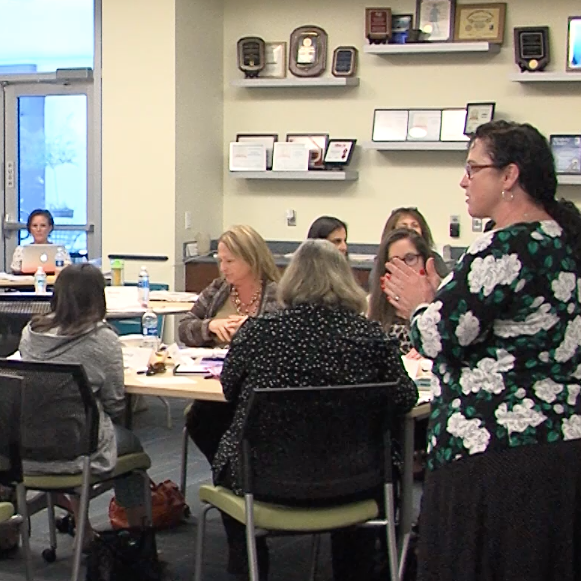
For seven years, I’ve shared the brain science of Mind in the Making (MITM) with people from all walks of life. Thus far, approximately 100,000 educators, community leaders, families and professionals from education, libraries, medical facilities, museums, nonprofits, law enforcement, mental health, churches, prisons and more have participated in the MITM Learning Modules.

These Learning Modules lead with science, combining deep research focused on executive function skills, with signature science-fueled learning. The training provides opportunities for adults to examine themselves, the research and the actions they can take to promote effective learning in themselves and in children. The training is based on the book, Mind in the Making: Seven Essential Life Skills that help adults understand and encourage the critical executive function-based skills children need to thrive.

No matter how many groups I work with—regardless of the varied reasons they begin the journey—it’s been so gratifying to see the connections forged among individuals and communities who attend the trainings.

Why is this so gratifying? Because it’s rare to create a platform and an experience where people with high levels of education and people with very little education learn from each other, where different cultures and ethnicities come together and feel empowered by each other, and where various professions and points of influence in children’s lives converge on commonalities rather than on our differences.

MITM provides a rare instance where individuals take the time to reflect about their own Life Skills and how they want to move forward while applying the science in their own lives.

Our process engages families, communities and sectors in new ways, in a true cross-sector collaboration. This is community building and as a bonus, we level the playing field and give states and communities ways to join forces and accomplish change together.

Also inspiring: the decisions people make, the goals they set and the perspectives they gain. Some of my favorites include when the connection between the science and Life Skills help people set goals that put the research into daily practice. Self-directed, real-life application becomes a game changer. For example, this happens when a co-worker decides to work on Focus and Self Control by practicing being a better listener instead of trying to fix something or interject ideas. Or when a parent or caretaker decides to ask more questions to improve Perspective Taking skills. Or when the teacher steps back and reflects upon the relationships with families in a new light that leads to improved Communicating skills.

Another favorite part of the learning journey for me is witnessing the paradigm shift among participants who learn that we can only set goals for ourselves, not for children or other adults. It is powerful when adults put the actions and desired outcomes on themselves. For instance, instead of a teacher asking young children to sit and listen to develop Focus and Self Control, the teacher sets a goal grounded in research: play more skill games and teach strategies to promote Focus and Self Control. Children benefit when we begin with adults.

I particularly love how the Life Skills empower people to look at themselves and at children with a genuine and effective strength-based lens. The Life Skills and strategies to promote the Life Skills provide space for participants to remember that if they are struggling, they are not innately flawed or “at fault” or “bad parents.” These skills can be developed with strategies and practice, and MITM provides the science, strategies and practice.

Keeping the love of learning alive for adults and children—the mission at the heart of Mind in the Making—is what keeps me passionate about this work. It boils down to our humanness while building on a solid foundation of effective teaching and learning, science, child development and goal setting. We connect the science and the communities so people can keep or reignite their love of learning to help children do the same.

Mind in the Making and all the people I have worked with have been gifts beyond description. Bringing the science and heart together is a winning combination that transforms lives.

When Should We Begin Promoting Focus and Self Control?

When Should We Begin Promoting Focus and Self Control?

When Should We Begin Promoting Focus and Self Control?

The skill of focus and self control begins to develop in the early childhood years, but it doesn’t fully become established until the later teen and early adult years. The prefrontal cortex is among the last parts of the brain to mature. Adele Diamond says she is repeatedly asked:

How can you say that a three-year-old or a four-year-old is capable of any kind of executive function? The prefrontal cortex is too immature. The analogy I like to use is: Think about a two-year-old’s legs. Your legs at age two are not at their full adult length; it may take ten or fifteen years to reach their full adult length—they’re very immature. But even with those immature legs, a two-year-old can walk; a two-year-old can even run. So the legs, even in their immature two-year-old state, are capable of serving a lot of the functions that legs are supposed to serve.

She concludes:

An immature prefrontal cortex is capable of supporting a lot of the functions it’s supposed to support. So even babies, toddlers, and kindergarten children are capable of exercising executive functions to some extent.

How Can Focus and Self Control Be Improved?

I find Adele Diamond’s analogy to walking and running very logical. How well would we walk and run if we weren’t allowed to do so until our legs were fully grown? When we see children crawling, pulling themselves to stand, and demonstrating other cues of readiness, don’t we naturally encourage them to strengthen and train their muscles, nerves, and bones to perform these complex skills by helping them to (literally) take “baby steps”? It should be no different with the skills of focus and self control—and the good news is, it’s possible.

It’s a fast-moving modern world and we’re easily distracted, but staying on task is important. Focus and Self Control involves Executive Functions of the brain. These are the skills used to manage our attention, our emotions and our behavior in order to meet goals. These skills begin to develop when children reach preschool age and continue to develop through the school-age years and into adulthood.

Children learn to focus over time and with practice.
Be aware of typical child development.

Your preschooler is still working on developing the skill of attention and self-control. At this age, it’s common for children to get distracted or disinterested in an activity.

Watch your child and ask questions.

To learn how to help him develop focus and self-control, it’s important to understand what your child is telling you with his behavior. Be a detective and watch your child in these moments. Ask yourself questions like:

Praise your child’s strategies.

At the Bing Nursery School at Stanford University, when children are given a hard puzzle, teachers reinforce the children’s problem-solving strategies using words like: “Look, you turned that piece around and around to see where it would fit.” Although the children struggled, they didn’t give up. Based on studies of what helps children continue to work hard in the face of challenges, parents and other adults praised their efforts or strategies, not their personalities or intelligence.

When you recognize your child’s strategies, regardless of the length of time he spends on an activity, you encourage him to keep trying, even when things are hard. Tell your child things like:

“You were using the materials so creatively on that picture. I wonder if you can finish it.”

“It looked like you were matching colors on that puzzle. Can you show me how?”

Encourage exploration.

Your child is still exploring the world through his senses and testing out his ideas. This exploration may seem chaotic to you, but your child may be taking the lead in his own learning. Here are some things to do with him to promote Focus and Self Control:

  1. Extend your child’s learning by looking for toys or reading material that build on his interests. Make sure to rotate these items so he doesn’t get bored. He’s more likely to stay focused when he’s fascinated by something.
  2. Limit distractions. Don’t put too many toys out at once. In addition, eliminate distractions. The studies of Daniel Anderson of the University of Massachusetts at Amherst showed that children are more unfocused when the television is on, even it is in the background.
  3. Offer a variety of ways for expression. Does he prefer to write, draw, sing or have hands-on experiences? When he’s engaged, he’s more likely to be motivated and pay attention.
  4. Promote your child’s curiosity by asking lots of questions and encouraging him to ask them, too. “Wh” questions, like “who,” “what,” “why,” and “when” are great prompts for discussions.

Doing things over and over helps build your child’s memory. Even if he only plays with the same puzzle for a few minutes at a time, he’s learning to master a task while building his abilities to focus and remember. The more experiences your child has, especially with things that interest him, the more likely he is to build skills of focus, memory, creative thinking and self control.

Play games that promote Focus and Self Control.

The more experiences your child has, especially with things that interest him, the more likely he is to build skills of focus, memory, creative thinking and self-control.

  • Play games like “I Spy,” “Simon Says,” and “Red Light/Green Light.”
  • Play games with rules, like board games and sports.

Even when you play pretend with your child, he is required to use his Focus and Self Control to stay true to his character and his memory to recall what he is supposed to do.

Interested in Mind In The Making Training?

Find out more!

Your support will allow us to continue to deliver our high-quality research, publications, and services to you. Families and Work Institute is registered as a 503(c)(3) non profit organization
EIN 13-3560042.

To provide a Corporate Gift or have Donation questions – Please email donate@familiesandwork.org